
Saturn is a jewel of the night sky, and a favorite to view through a telescope (although it WAS beaten out by the Moon in our Pre-Chat Poll!), but becomes more beautiful the closer you get. Pretty pictures were not the goal of the Cassini/Huygens mission, but they are a wonderful by-product of a study of Saturn's rings, moons, atmosphere, and magnetic field. 61 OLC participants heard about the mission from the Jet Propulsion Laboratory's Rachel Zimmerman-Brachman during Thursday's Live Chat.
Rachel gave some background on the Cassini mission, from its inception to launch back in 1997. It took seven years to travel the distance to Saturn, settling into an orbit that would allow it to investigate the rings and moons. Piggy-backing was the Huygens probe, built by the European Space Agency. Huygens separated during the cruise phase and aimed straight for Saturn's largest moon, Titan. Titan is unique as the only moon with an appreciable atmosphere, so Huygens was equipped with a heat shield and parachute to allow it to descend to the surface of the moon, taking pictures along the way of interesting landforms and methane lakes. Rachel talked about the 'methane-cycle' where the liquid methane would evaporate and rain down. Cassini, meanwhile, continued to orbit Saturn.
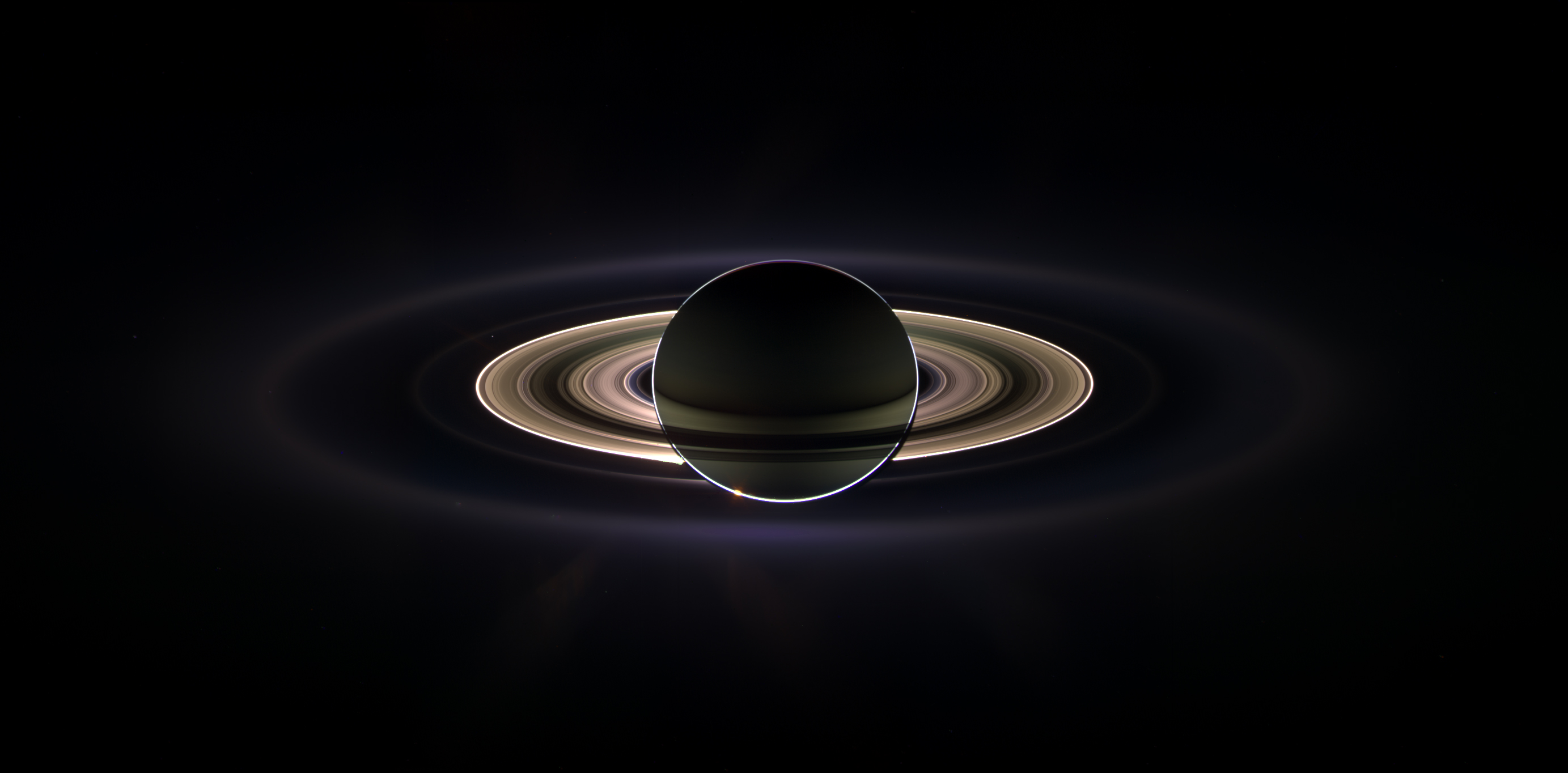
The rings are more varied and structured than imagined, composed of particles from house-size to a grain of dust. It is a goldmine of information in the study of gravity and orbiting bodies and how they interact with one another. Here is a beautiful image of Saturn and its rings, taken from a vantage point never before available.
 |
| Click for large image |

No comments:
Post a Comment