Friday, April 30, 2010

By Wayne Hale, JSC, TX

As a young boy I was enthralled by the stories of building the first transcontinental railroad. I still have the picture book from my school days which is full of black and white photos from 1868-9. As an engineer, I am fascinated with the period locomotives, the rolling stock, the tunnels, the bridges. As a program manager, I have an abiding interest in the logistics, the planning, and the execution of a project of such magnitude.

So I was terribly surprised several years ago when I read my first “adult” history of the building of the transcontinental railroad. Written by serious and professional historians, leaving behind the halcyon accounts which are carefully sanitized for young readers, I was surprised to find that the great achievement was not what I had been taught in my youth. Yes, these serious histories told about surveying the route, building trestles over prairie coulees, digging tunnels through the Sierra Nevada, bridging the Green River, organizing the logistics of the work for record breaking track laying. Yes, that was all there, but those herculean efforts were mere sidelights, incidental to the real story.

Because the real story was about . . . the money.

Everybody knew that railroad technology in the late 1860’s was fully capable to traverse the continent. There was no question that rail travel from the eastern states to California was desirable. The problem was the business case; the return on investment.

Do you see the parallels with today?

Starting as early as 1827, railroad development in America was subsidized by government. This followed the tradition of government subsidies to road builders and canal diggers. Blame it on the city of Baltimore who was the first to devote public funds to the B&O Railroad (Baltimore and Ohio – yes, it’s on the monopoly board!). In ’27 and ’28 the city invested the unimaginable sum of $1.5 million dollars. It took more infusions of money and almost 20 years before the railroad reached Wheeling, West Virginia. In my research it is unclear if the B&O ever really made it to Ohio.

This sort of story happened all over the United States. Cities and State governments poured money into the railroads. Not always to good effect, one might note. But it helped, in a major way, to develop the rail transportation system that is still in use today. The Federal government lent a hand by donating almost 25 million acres, by 1850, to be used to subsidize railroad building.

So when the transcontinental railroad was proposed, the only real question was whether it would be profitable enough to pay back the capital investment which would be required for its construction. The business establishment quickly came to a negative conclusion.

So the Federal government had to step in and offer incentives and subsidies. For example, the government provided to the builders a subsidy of $16,000 per mile of track laid (more if the terrain were mountainous). And when the railroad was complete, the Federal government provided many sections of land (a section is one mile square) alongside the right of way. Actually for ten miles either side of the track the land was surveyed into a checkerboard pattern with alternating squares given to the railroad as a subsidy and alternating sections retained by the Federal government.

The technology was ready, the need was there, and with the subsidies the project took off. The rest, as they say, is history.

So we should learn from this, right? If we want the nation to have a “railroad to space” we should take this lesson from history and apply it today. Perhaps it is not so important to argue about the configuration of the rocket or the exact parameters that its design must meet as it is to understand the financing and the provision that the government has to make to get a new industry started.

Hey, I’m just a government bureaucrat; I don’t know how business really works. But this money thing seems really important to investors. Maybe we should pay some attention to that, too.

I don't know how incentives may work this time. Clearly we don't have land to give away along the road to space. Does it involve tax breaks for investments in commercial human space services? I don't know. But we need to give that as much thought as we give to the engineering standards and requirements.

In the final analysis, the Federal government made more money from land sales (all those sections near the right of way became very valuable) than the Federal government provided in subsidies. In fact, one of the provisions was that Federal officials and military troops would travel for free on the transcontinental railroad; the Federal government “cost avoidance” in free travel for its military more than paid for the railroad subsidy. So from a taxpayer standpoint it was a great investment!

And even more importantly, the railroads tied the nation together. Rapid, reliable, economical transportation fueled American's economy in vast and profound ways. The galvanizing affect of doing something "that could not be done" gave the young nation a sense of pride and an example of what innovation and hard work could accomplish.

But the history lesson is not complete. (Did you expect a rosy ending?)

Both the Union Pacific and the Central Pacific were in bankruptcy within 5 years of the completion of the transcontinental railroad. New management adopted draconian business tactics to make the railroads profitable: this gave rise to the “Robber Barons” of the “Gilded Age”. And the railroads, especially the Central Pacific, invented that quaint practice that we call “lobbying”. Yes, an entire additional “industry” was added to the national economy; this one centered in the District of Columbia. You can make your own judgment about the value that lobbying has brought to the nation.

Finally, there was the Credit Mobilier scandal. Many of the politicians which had to approve the subsidies for the transcontinental railroad bought stock in the railroad companies – or were given stock for their votes. Money changed hands in ways that would be illegal today. The resulting scandals went on for 40 years. As one historian remarked, it took until all the politicians of 1870 had died before the mess was cleaned up.

So we need to learn from that, too. Hopefully the law will prevent those kinds of excesses from occurring. Hopefully.

Anyway, when you hear folks talk about building a new industry, think about the business case.

And what incentives the government may have to provide to get that industry to take off.

Literally.

Live Chat Roundup: April 29, 2010

It's Friday morning again and time for another Live Chat Roundup.  36 students took part in our chat last night with Distance Learning Network (DLN) coordinator Kelly Witherspoon.  The DLN provides a virtual classroom for students all over the country.  Communication is two way as both the DLN and the school has cameras and microphones so the NASA presenter can see and hear the class.  Teachers reserve programs and at the right time everyone connects together.  To find out more about the DLN and check out some of their web programs go to http://dln.nasa.gov/dln/ or checkout the DLiNfo Channel at http://dln.nasa.gov/dln/content/webcast/dlnstreaming.jsp.

Back to the presentation:  Mr. Witherspoon gave a great historical rundown of the Stennis Space Center in Hancock County, Mississippi.  Stennis is the world's premier site for the testing of rocket engines.  Originally built to test the engines of the Saturn V moon rocket, it required a 125,000 acre buffer zone to protect its neighbors.  Even so, when the five F-1 engines of the Saturn V were test it broke windows 5 miles away!

One thing that Mr. Witherspoon did not mention was the great visitor center at SSC, the Stennisphere.  Park at the Mississippi Welcome Center off of I-10.  You'll know you are in the right place because a full sized Lunar Module overlooks the parking area!  Hop on a bus and you'll be whisked to a great museum with some fascinating artifacts, including the very first Apollo capsule to be launched by a Saturn V, the Apollo 4.

Our thanks go to Mr. Witherspoon and the students who took part in the evening.  Have you attended a Live Chat?  What are you waiting for!  Our next chat is Thursday, May 6 at 8:00pm CT with aerospace engineer Mark Moore.  To get an idea of what Mr. Moore does, check out this video of one of his designs, then log-in next Thursday.  See you then!

Tuesday, April 27, 2010

A Drop in Science

By Heather Smith, MSFC, AL

One. Two. Bam! Time’s up. That’s how quickly the time passes when an experiment is dropped in the 2.2 Second Drop Tower at NASA’s Glenn Research Center.

I came to Glenn, near Cleveland, Ohio, this week for the Dropping In a Microgravity Environment, or DIME, event where teams of students are conducting science experiments in the drop tower. It works just like it sounds: Experiments are dropped down a giant hole, and during the drop they experience 2.2 seconds of freefall, or microgravity.

When I first heard about this event, I couldn’t imagine what kind of scientific data could be collected in a mere 2.2 seconds. But now that I’ve seen the frame-by-frame videos that are recorded during the drops, 2.2 seconds is longer than you think. DIME program manager and NASA researcher Nancy Hall, who is helping students with their drops this week, said a lot of the experiments done in the tower have to do with liquids and combustion.

One of the experiments dropped Tuesday was looking at how digestion is different in microgravity than in Earth gravity, which is a pretty important topic since astronauts on the International Space Station are eating and digesting food all the time. To look at this, students created a slurry of cheese crackers, applesauce, and water and placed the mixture in a syringe. During the drop the syringe contents were injected into a container of liquid. DIME coordinator Dick DeLombard said, “It’s like you ate a bunch of crackers, some applesauce and drank some water,” to which Chris Hartenstine from Glenn’s education office added, “and then fell into a hole,” much to the laughter of the students and researchers.

On the slow-motion video of the experiment during the drop, you can see the pink-colored slurry go into the liquid and sort of plume outward. Kendrick, one of the students from the Plattsburg High School team, said preliminary data showed the food mixture dissipating a lot slower in microgravity than it did during their ground tests. When we left them Tuesday, they were tweaking a few variables, such as changing the fluid level, to see if they would get different results and were dropping their experiment several more times throughout the day.

The DIME project and its sister project What If No Gravity, or WING, for middle school students, will drop a total of 30 student-made experiments in the tower in this year’s project. Check out some of the WING experiments in the WING Image Gallery.

Monday, April 26, 2010

Live Chat Roundup: April 22, 2010

By Jim Gerard, INSPIRE Education Specialist, KSC, FL

Sorry this Live Chat Roundup is late.  I would like to report a great chat last Thursday evening with Tom Pagano, Project Manager for the Atmospheric Infrared Sounder (AIRS) on the Aqua satellite.  Mr. Pagano talked a little about the engineering of the instrument, how it images the Earth's atmosphere in the infrared band of the electromagnetic spectrum, and how that data has been used to help perfect models of the atmosphere and investigate climate change.  36 students were on hand to watch the presentation and then offer questions.

We did have some technical issues, but hopefully not any that impacted the evening.  We ask our speakers to test their access to the room with a temporary log-in, but in this case our guest had just finished some meetings at CalTech and had a firewall issue when he tried to enter the chat room.  So we went with Plan B (always have a Plan B!).  This involved Mr. Pagano narrating to me his presentation, which I typed in for him.  What many students do not know is that we have a telecon going on with our presenter to handle technical issues such as this.  As our presenter spoke, I quickly typed what he said into the text window.  SInce he was not typing, Mr. Pagano used this time to travel back to his home, about an hour away.  This was our first chat where the speaker was mobile!  At one point, his signal was lost as he drove through a canyon, but was regained after only a moment.  I hope you never noticed this, but just enjoyed a very informative presentation.

We ran out of time for Q&A, but Mr. Pagano was able to answer a couple questions afterward.  here they are:

EA asks:  What has your mission discovered about pollution in the air? Is having more water vapor in the atmosphere good or bad?

Tom Pagano answers:  Esmeralda, by watching the carbon monoxide transport in the atmosphere, we can see the effects of wildfires hundreds of miles away in California affecting the air pollution of large cities like Houston. We can observe stratospheric-tropospheric exchange of ozone that leads to increased air pollution near the surface. We can now see ammonia emitted from farming, and global emissions of carbon dioxide.

Increased warming leads to more water vapor in the atmosphere. This further increases global warming (positive feedback) because the water acts like a blanket. It has been also proposed that more water vapor in the atmosphere leads to “negative feedback” by generation of more clouds in the lower troposphere that will reflect sunlight. The strength of the negative feedback is expected to be much smaller and has not yet been quantified.

JR asks:  So, Water Vapor is like a catch 22 situation, the more global warming, the more water vapors in the upper atmosphere trapping infrared radiation! Thanks for

Tom Pagano answers:  Yes, we call it positive feedback.

That's all for now.  Next Thursday we will here about the mission and facilities at the Stennis Space Center in Mississippi from education specialist Kelly Witherspoon.  Just a thought: since our last chat was carried out by a presenter traveling 55 mph., how about one traveling at 17,500 mph.?

Wednesday, April 21, 2010

Moon Driving

By Heather Smith, MSFC, AL

Four years ago the project managers behind the NASA Great Moonbuggy Race came to us with an idea for a feature article: for the first year in the race’s 14-year history, teams were coming from outside the United States, specifically from Germany and Canada.

Since that time, the race has become a truly international event with teams this year from 18 states and Puerto Rico, Canada, Germany, India and Romania! The international teams are making quite the showing too, giving the more seasoned moonbuggy teams quite a challenge. This year, the team sponsored by the International Space Education Institute of Leipzig, Germany, placed first in the high school division, and the University of Puerto Rico in Humacao took first spot in the college division. The University of Puerto Rico team has competed in every moonbuggy race since the event started in 1994, and finally, in 2010, made a first-place finish.

Having observed the race year after year, I can assure you the moonbuggy course is no easy feat. Students’ buggies must endure simulated lunar craters made out of tires covered with gravel, plus curves and steep hills. “Luna”-tic Curve is one of the more notable elements on the course and has been known to wreck a buggy or two. The 90-degree turn comes at the foot of a hill. Just before making the turn teams bounce over a rocky crater. This year team after team performed extremely well on what has a reputation for being one of the most difficult elements on the course.

My co-worker David and I pedaled one of the demo buggies around the parking lot, and even that proved difficult. Changing gears, pedaling and steering a four-wheeled, bicycle-like vehicle, all at the same time, on a flat surface was harder than I thought. I think I would fail miserably if I had to do all of those things over a mound of sand or gravel or tires, like are on the course. In our short circle around the parking lot we nearly crashed into a tent, David had to use his feet to stop us from hitting someone (that, by the way, would’ve been a one-minute ground touch penalty if we were on the course), and afterward we were a little out of breath. What incredible skill and stamina these students have to do that and do it well.

Check out the NASA Great Moonbuggy Race page on NASA.gov for photo galleries and more from this year’s race.

Tuesday, April 20, 2010

Discovery Lands at KSC

by Jim Gerard, INSPIRE Education Specialist, KSC, FL

Discovery is ten minutes away from landing here at KSC as I start writing this. Through the walls of the HQ building I have heard the jet rumble of the Shuttle Training Aircraft, a modified Gulfstream 5,  which flies the route before landing to visually check on weather conditions. Specially equipped with flight-deployable air breaks it can 'hang' and drop in the same landing approach as the orbiter. The shuttle itself drops faster and steeper than a normal aircraft, so training orbiter pilots demands a novel test vehicle.

Here I go outside. More in a minute....

BOOM! BOOM!

And by the time I'm back at my desk, the orbiter is wheels stopped on Runway 33. A beautiful sight, as this approach brought the orbiter almost directly over HQ. Orbiter and crew now safe and sound on Terra Frima.

A few things to know about these events (and there are only three more left, so listen up!):

The two sonic booms are produced by shock waves emanating from the orbiter nose and tail.

After the booms, you can hear the sound of the orbiter cutting through the air, and possibly the APUs (auxillary power units). Which is what the booms are: the compressed sound waves of all the soundthat would normally precede the orbiter (this is a very rudimentary explaination).

The STA follows a minute behind the orbiter.

While thousands of people may come to the center to watch a launch, only a few hundred are invited to the landing site.  The viewing area is close enough that, if hypergolic fuel is leaking from a valve in the reaction control system, evacuation must be immediate.  Busses are left running in case of this emergency.  It is also why you see the first responders dressed in the full emergency suits with airpacks.

Technically speaking, the orbiter does not 'fly' or 'glide' until the last 30 seconds or so when the nose elevates above the horizontal.. That is when the wings start producing lift.  Everything before that is a 'controlled descent', or what my friend Buzz Lightyear refers to as "Falling with style!"

The drag produced by the creation of lift also rapidly drops the airspeed, threatening a stall.  The art is to hold off the stall until touchdown on the runway.

Runway 33 and Runway 15 are the same runway.  The numbers indicate the approach heading, 33 toward the north at heading 330º, and 15 toward the south at heading 150º.

Time to end this and post while it is still timely.  While launches are magnificent, landings are exquisite.  I would almost prefer to watch a landing.  Guess I'll have to figure out how to get a ride with the Navy for the future.

Friday, April 16, 2010

Live Chat Roundup: April 15, 2010

By Jim Gerard, INSPIRE Education Specialist, KSC, FL

Last night was a slightly different LiveRoom chat with aerospace engineer Antja Chambers from Johnson Space Center. Ms. Chambers was unable to open the LiveRoom Java client and could not enter the chat room! What you may not know, INSPIRE staff and the presenter are on a 'backstage' telecon where we can support the presenter and troubleshoot issues such as this. As the time to begin grew near, we decided on a Plan B: Ms. Chambers would narrate to me her presentation and I would type it in the text window for her. My name may have appeared next to the text, but it was all Antja Chambers' thoughts! I hope you enjoyed hearing about the path she took to NASA and some of the interesting work she does there.

Ms. Chambers' current job is to help develop the tools that astronauts use during their spacewalks. If you go to see the new Imax movie "Hubble 3D" you will see many samples of her work. She mentioned over the phone how excited she was to see things she has built and handled up on that huge screen! If you have yet to see the film, hopefully you will think of Ms. Chambers and the many other engineers who make missions like the Hubble Servicing Mission possible when you get your chance to watch it.

You can read through the event by clicking on the 'Chat Archive' link on the bottom left of the OLC Home Page.

Tuesday, April 13, 2010

Managing Your OnLine Reputation

By Linda Cureton, CIO, NASA

Concern about reputation is a barrier for many organizations and individuals preventing them from fully harnessing the power of Web 2.0 technologies.  Consider the Oscar Wilde quote that says:
“One can survive everything nowadays, except death, and live down anything, except a good reputation.”
So clearly having your personal reputation or your organization’s reputation blemished is a serious matter to be reckoned with.  Many organizations are struggling with how to develop policy around rules of conduct for when disgruntled employees inflict damage on their reputation.  Because of this, there’s a cottage industry of businesses that have popped up to repair what turned out to be damaged company reputations.  Here, I will speak to what you can do an individual to take responsibility to manage your own online reputation.
Perhaps you think this isn’t important to you.  Perhaps you are even unaware that this is a problem to be reckoned with.  Any Ostrich with his head in the sandexecutive or leader reading this should get their head out of the sand and wake up to the urgency that demands that we become proactive about our reputation. Furthermore, the carefree youth today may want to take an opportunity to NOT learn the hard way, by losing professional opportunities due to the apathy experienced in early life.
In an August 2009 article, New York Times reported that employers are starting to use Social Networking to check out job applicants.   The article reports the results of a June 2009 survey that Harris Interactive did on behalf of CareerBuilder.com:
§  Forty-five percent of employers use social networking sites to research job candidates
§  Eleven percent plan to use these techniques for screening
§  Industries that specialize in technology and sensitive information are most likely to screen job candidates via social networking sites or online search engines
The survey results also reported that when employers did NOT chose a candidate for a job, the reasons were most likely as follows when the potential employee:
·         Posted inappropriate photographs or information - 53%
·         Posted content about them drinking or using drugs - 44%
·         Bad-mouthed previous employer, co-workers or clients - 35%
·         Showed poor communication skills - 29%
·         Made discriminatory comments - 26%
·         Lied about qualifications - 24%
·         Shared confidential info from previous employer - 20%
You still don’t think this blog is about you? Do you? Let me bust some myths.
Myth (1): I don’t even use this social networking junk, that’s for kids.  So, I don’t have a problem.
I did a search on the name of one of my 10 favorite NASA CIOs “Chris Kemp” … the first hit? Mug shots! How does one cope with this? Well, there’s a comedy bit out there where a spouse gets caught in a compromising situation face-to-face with their spouse.  They simply insist “Baby, that wasn’t me!” Well, you can try that because it may work.  Or you can do what Chris does and use his middle initial.  There’s lots of good content about “Chris C. Kemp.”
Myth (2): Look, I am a seasoned user of this technology; I have enough sense to know what to say and what not to say?
I have a wonderful tech-savvy geezer colleague who truly understands these things.  He hooked up with the wrong “intelligent” application on a popular social networking site.  So, I sent him a message that went something like this:
Diva: “Dude? XXX movies??”
Geezer: “Huh?”
Diva:”Can you just take that stuff down?”
Geezer:”Ok I took it down, but that wasn’t me!!”
Myth (3): See, that’s why I have personal and private accounts … I keep it separate!
NY Times reported a case of a police officer who had a little fun talking trash on MySpace.  Well, that locker room banter crept into his professional life and affected the outcome of the cases he worked on.  The fact that it was a separate private account, didn’t affect his outcome professionally.
So, what’s person to do?  Here are three tips:
(1)   Defend against any possibility of bad content by overwhelming it with good content.
Use the superpowers of Web 2.0 for good.  Even though what’s out there is more or less permanent, overwhelm the bad content with intentional good content.  Use professional sites to do networking in your field.  If you wondered about the advantages of doing a professional blog, here’s one for sure.  You can also comment on other people’s blog.  Another possibility is to use micro blogging sites like Twitter to establish a professional reputation.  Be careful not to overdo it.  Too much content casts doubt about what your professional priorities are.
(2)   Actively monitor content about yourself.
You can set options in various search engines to alert you when there is new content posted with your name.  Ignorance can be bliss, but in this environment, it’s not. You need to at a minimum be aware of what is out there.
(3)   Private is private, but there is no personal.  Everything is public on the information super highway!
Many social networking sites are increasing their functionality to provide more privacy.  Leverage these capabilities.  It won’t hurt to initially be an observer on the side line before you jump in.  You can learn from others. 
Now just in case you think this blog isn’t about you, here are some final results of the Harris Interactive survey.  Eighteen percent of employers reported they have found content on social networking sites that caused them to hire the candidate:
·         Candidate’s profile provided a good feel for the candidate’s personality and fit - 50%
·         Candidate’s profile supported their professional qualifications - 39%
·         Candidate was creative - 38%
·         Candidate showed solid communication skills - 35%
·         Candidate was well-rounded - 33%
·         Candidate had a good reputation as indicated by other people who posted good references - 1%
·         Candidate received awards and accolades - 15%
Final words
·         Be professional at all times and be careful with sarcasm.  Think before you publish. 
·         Contribute and interact on a professional basis.
·         Maintain content about yourself and ensure that it is kept up-to-date.
·         Respect copyright laws, financial disclosure laws, and any policy that your employer may have.
Warren Buffet is quoted as saying that, “It takes 20 years to build a reputation and five minutes to ruin it. If you think about that, you'll do things differently.” Start now, and build YOUR online reputation.

Monday, April 12, 2010

Connecting with NASA

There are a number of ways for you and your students to stay connected to NASA’s missions, projects and research. NASA has a presence on several social networking sites that you and your students may be familiar with, including Twitter, Facebook, Ustream TV, MySpace, YouTube, and Flickr. You even can subscribe to one or more NASA podcasts on iTunes and have the content played on your Mac or PC computer, an iPhone, ipod, or iPad. To learn more about staying connected to NASA, visit http://www.nasa.gov/connect/index.html or http://www.nasa.gov/rss/index.html.

But perhaps the easiest and most dynamic way to stay connected to NASA is through the official NASA app. The NASA app allows you to discover a wealth of NASA information right on your iPhone, iPod Touch, or iPad. You collect and customize the delivery of an extensive selection of dynamically updated information, images and videos from various online NASA sources in a convenient mobile package. It’s available free of charge at the App Store within iTunes. Or you may install it directly on your iPhone, iPod Touch, or iPad using the App app. To download and install the NASA App into iTunes, go to http://itunes.apple.com/app/nasa-app/id334325516?mt=8.

And don't forget, you can now get INSPIRE updates via Twitter!  After setting up a free Twitter account, click on the link on the bottom left of the OLC Home Page for the Twitter link.

Friday, April 9, 2010

Live Chat Roundup: April 8, 2010

By Jim Gerard, INSPIRE Education Specialist, KSC, FL

Another great chat in the OLC LiveRoom last night with KSC Senior Mission Manager, Wanda Harding. Ms. Harding talked about the work it takes to prepare a launch of a space probe. She worked with LRO/LCROSS, and is currently working on IBEX and the upcoming Mars Science Laboratory which will place a nuclear powered rover on the surface of Mars. Ms. Harding was very motivational in her conclusion, reminding students of the important qualities needed to succeed in whatever they do. I encourage everyone who could not attend last night to read the transcript in the archive found on the OLC Home Page.

Bonus Question from 4/8:
MR asks: Is Constellation officially canceled now? I thought that congress still had to pass the new budget.
Answer: Yes, Constellation is officially cancelled, and true, the budget has not been passed. There has been effort from some to fund a 'Constellation Lite' but nothing is concrete yet. There is a big meeting at KSC on April 15 with a speech by the President that could help answer some questions. Many Constellation contracts will continue until they expire at the end of the fiscal year. So even with a cancellation you will still hear Constellation news over the summer.

Thursday, April 8, 2010

Tonight's LiveChat Guest: Wanda Harding

By Susan Giblin, INSPIRE, KSC

The Live Chat this Thursday, April 8, will be open to all grades and will be hosted by Wanda Harding from the Flight Projects Office at Kennedy Space Center. Ms. Harding will chat with INSPIRE students about the role of Expendable Launch Vehicles in the exploration of space. Ms. Harding is the mission manager of the Flight Projects Office of the Launch Services Program
Wanda did not always plan a career in space science. As a child in Atlanta, Georgia, Wanda often dreamed about becoming a concert pianist. It wasn't until she enrolled in a science-focused high school that she discovered her interest in engineering. "I was motivated by the challenge. It was something different, so I decided to try it out," she said. She still finds time for music by playing piano for the children's choir at her church.
After high school, Wanda earned a bachelor's degree from Hampton University and master's degree from Georgia Institute of Technology, both in electrical engineering. She credits her parents with inspiring her to pursue her dreams. "My parents were both educators and excellent role models. They were also people that met challenges, and by doing so, have set a good example, not only for me, but for others as well," she said.
For young people who would like to follow in her footsteps, Wanda offers two pieces of advice: major in a math or science-related field and do your best to become a well-rounded person. "Because you will interact and interface with all types of people, it is certainly to your advantage to have exposure to other fields beyond your immediate major," she said.
Wanda hopes to inspire the next generation of space explorers. "The next chapter of my life may even include someday becoming a high school physics or math teacher," she said.

Wednesday, April 7, 2010

STS-131 - A Launch to Remember

By Jim Gerard, INSPIRE Education Specialist, KSC, FL

Working out of KSC I have been witness to many a launch. I know that launches at dusk or dawn can be particularly beautiful, as the light effects of the rising sun turn exhaust trails into works of art. Monday morning's launch of Discovery produced a display that surprised not only me but everyone at HQ I chatted with.


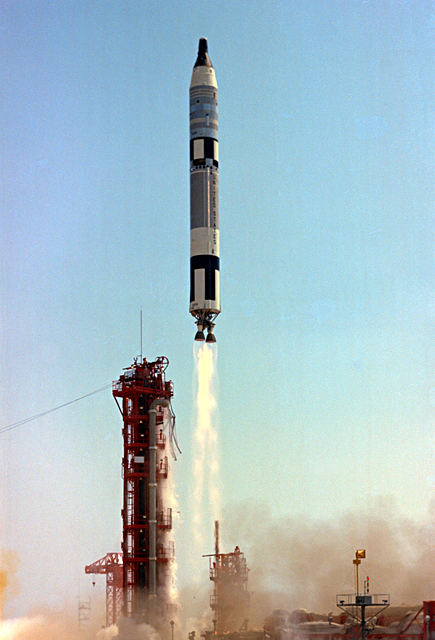
This beautiful display has some serious science behind it. You all know that as the orbiter ascends, it is traveling through increasingly rarefied atmosphere, until it reaches a near vacuum at orbital altitude. You also know that the Space Shuttle Main Engines (SSME) works off of Newton's First Law of Motion, and the action of the exhaust leaving the engine bell produces the reaction of the engine and shuttle moving away. The exhaust does not need to 'push' against anything to produce thrust. While this is true, the exhaust does push against something, the gasses of atmosphere.  At sea level, atmospheric pressure helps constrain the exhaust into the familiar plume we see.

This Gemini-Titan launch shows an exhaust plume 
constrained by sea level atmospheric pressure.
(Image by NASA)

As the rocket ascends,  the thinner atmosphere allows the exhaust plume to expand.  Engineers plan for this with the shape of the engine exhaust bell.  Second-stage engine bells designed to work at high altitude are different than those on the first stage booster.  Some engines are designed with an extendable collar that slips down at high altitude to take advantage of the expanding exhaust by increasing the length of the bell.

Notice different exhaust plume indications in this simplified SSME illustration.
(Image by Pratt and Whitney)

The SSMEs are designed to operate through the whole atmosphere, and optimized for mid altitudes after solid rocket booster seperation.  When the orbiter reaches higher altitudes the exhaust rapidly expands.  Although this lowers the efficiency of the SSME, the decreasing weight of the external tank and lack of atmospheric drag allow it to continue to thrust the shuttle to orbit.  The video above (which appears to have been taken from near the US 1 highway in Titusville, FL) shows this expanding plume.  Remember, this happens on every flight.  What made this different was the darkness of the sky and the plume being illuminated by the sun just over the horizon.  A beautiful confluence of technology and nature.
Aftermath of the launch plume in the light of sunrise.
(Picture by Jim Gerard)

Monday, April 5, 2010

Teacher plus Coach plus the Right Stuff equals Astronaut

By John Entwistle, NES

Selected by NASA as a Mission Specialist in May 2004, Dorothy M. Metcalf-Lindenberger, mom, teacher, and now Mission Specialist on STS-131, the 33rd launch of a shuttle, was an earth science and astronomy teacher at Hudson’s Bay High School in Vancouver, Washington. She also coached cross-country at the high school level for three years. In February 2006 she completed Astronaut Candidate Training that included scientific and technical briefings, intensive instruction in Shuttle and International Space Station systems, physiological training, T-38 flight training, and water and wilderness survival training.  Completion of this initial training qualified her for technical assignments within the Astronaut Office and flight assignment. Space shuttle Discovery carries a Multi-Purpose Logistics Module filled with science racks that will be transferred to laboratories of the International Space Station. Discovery successfully launched April 5, at 6:21 a.m. EDT. This is the last scheduled night-time launch. Discovery and crew will spend 13 days in space on their mission to the International Space Station.