Monday, February 28, 2011

J-2X Progress: Engine Assembly Starts!

By William Greene, MSFC

Ready…
Set…
Go!!!

After so many requirements reviews and concept reviews and safety reviews and design reviews, and after so many trade studies and analyses and assessments, and after so much paperwork generation and processing, and after so many programmatic meetings and technical interchanges and integration exchanges and formal boards, after all that, we have finally begun assembling the very first J-2X, Engine 10001, at the NASA Stennis Space Center (SSC) in Building 9101.

In the end, truly, it all comes to this: the hardware.  Everything that we do – and it is an astonishing amount of work – comes down to an operational piece of space launch hardware, a rocket engine (albeit a development unit first example).  It is sometimes quite easy to forget that fact after being buried in the mountains of necessary details for several years.  Yet that day has now arrived.

The Main Combustion Element (MCE), consisting of the Main Combustion Chamber (MCC) and the Main Injector (MI) mated together, arrived at NASA on 22 February 2011.  While a number of piece parts and components have been arriving at SSC for weeks, it is the arrival of this sub-assembly that marks the start of assembly.  It would not be too much of stretch to say that the rest of the engine, one way or another, hangs off the MCE.  So you need that part to get the whole process started in earnest.

The drawing below shows the first steps in stacking the whole thing together.


Your first question should be, "What's a Birdcage?"  It’s actually a simulator for the nozzle.  Because this is the first build of the engine and because the various components are not completing fabrication in the optimal sequence, we have found ways to expedite engine assembly such as the use of this nozzle simulator.  The whole engine will be stacked and assembled with the Birdcage acting as the effective pedestal for the process.  Then, when the nozzle does arrive, the assembled upper part of the engine will be lifted, the Birdcage will be removed, and then the assembled pieces will be lowered onto the actual nozzle assembly to be used for Engine 10001.  Below is a photograph of the actual Birdcage sitting in its packing box at NASA SSC.
(Now, I'm not going to burst anyone's bubble, but whoever first started calling this thing a "Birdcage" perhaps has a frightening impression of how large are the birds of southern Mississippi.  Those are some awfully large holes.)  Later, the Birdcage will be reused as the structural foundation for the assembly of the J-2X PowerPack Assembly to be tested next year.

The next picture is of the assembly area where the whole thing will be brought together.  There is a raised floor on which the technicians will stand and there is a recessed area where the dolly will fit on which the engine is assembled.  On the silvery metal carts shown – the so-called "bread carts" – the kits will be laid out for the next stage of assembly as the engine comes together.
One interesting little note about that picture of the assembly area is that in the upper left-hand corner you can see another engine within a big yellow piece of ground support equipment.  That is an RS-68 engine that flies on the Delta IV vehicle.  The J-2X assembly area sits right next to the RS-68 assembly area though they are distinctly separated.

Here are some other really cool pics:
Okay, so maybe "really cool" is a slight exaggeration.  On the left is a corner of the kit staging area where, on a pallet in the back (can you see it?), sits the first pre-arranged kit of engine parts to arrive at NASA SSC.  On the right are the two turbopumps for Engine 10001 still sitting in their shipping crates.  Trust me, as the assembly process moves forward, the pictures will get better.  Really.

So, J-2X is coming together.  Over the next several weeks, I will be posting pictures and descriptions of the process.  I do have to say, from a personal perspective, seeing this thing finally becoming a reality is quite gratifying.  Thank you all for coming along and sharing the ride.

Friday, February 25, 2011

Live Chat Roundup: February 24, 2011

By Jim Gerard, NASA INSPIRE Education Specialist, KSC, FL

As the Space Shuttle rises from its launch pad into the Florida afternoon sky, a cheer rises from the thousands gathered to witness the power and spectacle of the event.  A second cheer arises as the Orbiter detaches from its booster to continue its way into space.  A third cheer erupts minutes later as the booster flies overhead, with the mighty roar of jet engines drowning out the crowd as it makes its way to the landing strip. Whoa!  The booster flies back?  In the early design concepts of the Space Shuttle it did!  How the Shuttle evolved in design to the current configuration was the subject of last night's Live Chat which I had the pleasure to present to 61 members of the INSPIRE Online Learning Community.

We had lots of questions, and I was unable to get to them all.  Here are the questions (and answers!) from last night:

Q.  Regarding your "What's Next" slide...Why are we stopping the space shuttle four years from the planned deorbit of the ISS (keeping in mind political threats)?  In addition, if NASA hopes to continue manned missions, why is it eliminating the two initial and necessary steps for the developement of anything further: LEO and the space shuttle?
A.  When President Bush announced the Vision for Space Exploration in 2005, the idea was to build new launchers and spacecraft (Constellations) to service the ISS, build a Moon base, and travel to Mars.  The funds for that would come from the elimination of the Space Shuttle, which was a large part of the NASA budget.  Though Constellation was canceled, the cost savings of eliminating the Shuttle will be diverted to other programs, including the development of a Multi-Purpose Crewed Vehicle (Orion) that could be launched commercially.  NASA is also seeking out and spurring on commercial crewed vehicles like SpaceShipTwo and Dragon.  Oh, and the ISS will remain active until 2020.


Q. Is it possible to make a shuttle or rocket land like a helicopter?
A. Yes, but it was not NASA that accomplished it.  A small company called Rotary Rocket designed a test article called the Roton that would take off with rockets and then descend and land using a retractable rotor.  Read more at http://www.astronautix.com/craft/roton.htm


Q. How long did it take for NASA to come up with the shuttle design?
A. Official work began by NASA in 1968, but it was not until 1972 when NASA chose the North American (Rockwell) proposed configuration.  Changes continued until the first Shuttle flight in 1981.


Q. When the shuttle was launched today, it appeared that something fell off like maybe foam.  Do you forsee any problems with that?
A.  Foam from the External Tank was seen falling after the critical phase of flight.  Launch video will be examined.  Astronauts took video and images of the ET after separation that will also be analyzed.
You can hear more questions, answers and the rest of the presentation in the Live Chat Archives beginning on Monday.  Thanks to all the students who attended!

Tuesday, February 22, 2011

Poll of the Week: Steely-eyed Rocket Persons

By Jim Gerard, NASA INSPIRE Education Specialist, KSC, FL


Ask people what NASA does and you're sure to get an answer like "launch rockets" (or some variant).  Indeed, launching rockets allows NASA to send people and payloads to space - it is a means rather than the end.  This weeks Poll asked Online Learning Community members whether they have built and launched a rocket.  Specifically a model rocket.  Being a model does not make them less a technological device than the boosters used by NASA and the military - they are models in size, but not in function.  As a matter of fact, the typical model rocket has the exact same launch profile as the NASA rockets.  Compare these sketches of a model rocket and NASA's first manned spaceflight:

Model Rocket Flight Profile
Mercury-Redstone Flight Profile
It appears the majority of OLC has had a chance to build an launch a rocket.  Rockets of every kind, as well.  Here is what some had to say on the Discussion Board:
I've launched many a rocket. I have used nice cardboard one tht I made at USSRC and it almost landed on the roof of my brother's school when I used a C Estes engine (I was launching in the parking lot of his school. It was great.) When I lauched  Two-stage rocket, its nose got buried in the ground (launched at USSRC). :/
***
I launch rockets every chance I get. Most I design myself, but I also have launched common bottle rockets and store bought make it yourself rocket kits, though those aren't as much fun. My favorite rocket launch though was last summer when I launched a water rocket. (My design). It flew through my brother's open window and exploded, splashing water all over him and his cat at about 7 AM. :D
I also designed and launched an underwater rocket by using an air pump, (above the water surface), to pressurize the air tank and launch the rocket from the bottom of the swimming pool. It got about 15 ft. or so, pretty good for an underwater launch.
***
I don't get to do much during the year but every Christmas my uncles, dad, and I all build our own rocket and we go out to the local baseball field and launch them until we either lose them or run out of engines/fuses/batteries for the spark generator.
***
I launched a store-bought rocket in 6th grade science class, but my group put the tail fins on backward, so it never flew in the right direction.  We launched it twice before it got stuck in a tree.  I've also launched bottle rockets and paper "air-rockets."
 This week, we look at NASA's new vision statement: "To reach for new heights and reveal the unknown so that what we do and learn will benefit all humankind.".  What do you think of it?  Answer the poll on the home page, then support your decision on the Discussion Board.

Monday, February 21, 2011

Let's Roll!

By Angela Storey, MSFC, AL

On Feb. 17 NASA announced the roster of teams set to compete April 1-2 at the 18th annual NASA Great Moonbuggy Race -- and the race season is officially under way!

Ezra Logreira, left, and Karine Wittenborg, moonbuggy racers from the Huntsville
Center for Technology, are geared up for this year's Great Moonbuggy Race.
(MSFC/David Higginbotham)
Ezra Logreira, left, and Karine Wittenborg, moonbuggy racers from the Huntsville
Center for Technology, are geared up for this year's Great Moonbuggy Race.
(MSFC/David Higginbotham)

A total of 84 student teams have registered to roll out their wheeled wonders at the U.S. Space & Rocket Center in Huntsville, Ala. They include U.S. high school, college and university students from 22 states and Puerto Rico; and international challengers from six countries, including -- for the first time -- racers from Ethiopia, Pakistan and Russia. For the complete list of 2011 teams, visit http://moonbuggy.msfc.nasa.gov.

Every year, the NASA Great Moonbuggy Race challenges students to design, build and race lightweight, human-powered rovers -- tackling some of the same engineering challenges overcome by Apollo-era lunar rover developers at the Marshall Center in the late 1960s.

"This project engages the aerospace talent of tomorrow in hands-on engineering," said Dr. Frank Six, Marshall's university affairs officer and one of the race founders. "They learn by doing."

This year's race has a special historic impact -- 40 years ago, the first NASA Lunar Roving Vehicle was used on the surface of the moon. NASA's historic lunar rover made its inaugural excursion July 31, 1971, driven by Apollo 15 astronauts David Scott and James Irwin. Two more rovers followed in 1972, during the Apollo 16 and Apollo 17 missions.

Four decades later, moonbuggy racers strive to uphold the legacy of that engineering feat. Their challenge is to deliver a two-driver vehicle capable of posting the fastest vehicle assembly and race times, while incurring the fewest penalties on a course that simulates the harsh lunar surface. High school students square off in one division; college and university teams compete in another.

Race organizers expect another heated contest this year. But Six said he also looks forward to that special "moonbuggy camaraderie" on and off the course -- a hallmark of the event which transcends region, ethnicity and even language barriers.

"Students hailing from four continents come together in friendly competition," he said. "More importantly, they come to meet one another, to compare ideas and turn shared dreams of spaceflight into lasting friendships and future partnerships."

NASA will broadcast live race coverage via NASA TV and the online Webcasting service UStream. In 2010, more than 32,000 people around the world watched live coverage, including commentary from race organizers and chats with student racers.

Race enthusiasts also can track race news on Facebook at http://www.facebook.com/moonbuggyrace, and keep up with real-time Twitter updates during the race at http://twitter.com/moonbuggyrace.

Friday, February 18, 2011

Live Chat Roundup: February 17, 2011

By Jim Gerard, NASA INSPIRE Education Specialist, KSC, FL

What blew out every window of Mississippi's Stennis Space Center?  Was it Hurricane Katrina in 2005?  No, it was when they did a full test of a Saturn V first stage with 5 F-1 engines going full blast in 1966.  56 INSPIRE community members heard this and other facts about SSC last night from DLN Coordinator Kelly Witherspoon.  Dr. Witherspoon talked about the main mission of SSC - to test rocket engines - as well as some of the other agencies that reside in this 'federal city'.  Located close to the Gulf of Mexico in southern Mississippi, SSC provides a stopping point between the Michoud construction plant in Louisiana and Kennedy Space center in Florida to test the rockets that take humans to space.  There was an old saying around the community,"If you want to go to the moon, you first have to go through Hancock County, Miss."

Today, test stands are used to prepare for future rockets.  The RS-68 engine used on the Delta IV booster are even constructed there by Pratt & Whitney.  You will also find the largest concentration of oceanographers anywhere in the world at the Naval Meteorology and Oceanography Command.   You can check it all out by visiting the StenniSphere, SSC's visitor center, accessible from the Welcome Station on eastbound I-10.

Next week I'll be providing a presentation on the History of the Space Shuttle.  Sign-up begins Monday afternoon on the Discussion Board.  See you then!

Thursday, February 17, 2011

J-2X Extra: Shiny Metal Pieces

By William Greene, MSFC, AL


Finally, it has been discovered: Proof that rocket engineers can indeed have a sense of humor.  This is an exchange that actually happened in a meeting here at NASA not too long ago.

Manager #1: What are those feedlines made of?
Manager #2: Really shiny metal.

Translation: He didn't know, but he would find out.  Okay, so it’s not Saturday Night Live material, but it was funny in context.  (You had to be there…really.)

The truth is that we use lots and lots of different kinds of shiny metal in all kinds of strange shapes, under all kinds of severe conditions, and with uncompromising standards against failure.  We use aluminum and steel and titanium and copper alloys and nickel-based super alloys and, sometimes, rare earth metals and precious metals.  We cast it, forge it, roll it, spin it, weld it, you name it.  Suffice it to say that if you like or know something about metal working or machining or welding or metallurgy, then even if you haven't got a clue about rockets, we’ve probably still got a place for you.  It's a fascinating field that ranges from enormous factory tooling necessary for large structures production all of the way down to microscopic crystal formations deep within the parts being produced.

Now, the pursuit of new technology demonstrations has never been a primary objective for the J-2X development effort.  We are supposed to make it work – that’s the prime directive.  However, in the course of J-2X development, we came across a situation where we were forced to consider innovative solutions and, from that consideration, identified an opportunity to pursue something really pretty cool and it has to do with shiny metal.


So let's start at the beginning.  In order to avoid combustion instabilities in the gas generator assembly, we found that we needed a very short gas generator discharge duct.  What is a combustion instability?  In this case, think of a pipe organ.  The size of the pipe determines the pitch.  Big pipes make big booming sounds.  Little pipes make little whistling sounds.  What we found through component testing was that the pipe connected to the gas generator was acting like a pipe from a pipe organ and the sound was so big and so loud that it had the potential of ripping the whole thing apart.  To find a place where we were de-tuned from the booming loud vibrations, we had to make the pipe quite short. 


Now, though, we had a problem.  We had a duct so short that it basically looks like a U as pictured in the drawing above.  Note, however, that the unit used on the engine is welded on one end and flanged on the other.   This picture is a drawing of the test configuration.  But regardless of the flanges and such on the ends, this part is basically U made out of very high-strength "shiny metal" (a nickel-based super alloy).  Given the diameter of the tube, the strength of the metal, the thickness of the walls, and the fact that we can't allow the walls to get too thin from bending, we had a devil of a manufacturing situation for what looks like, on the surface, a relatively simple component.  So, we (and that's the big "we" of both NASA and our prime contractor, "Pratt & Whitney Rocketdyne") started looking for solutions.

Below is a picture of the baseline solution illustrated with a manufacturing demonstration unit.  Rather than trying to do the whole bend in one piece, it is done in three pieces, each with a 60-degree piece of the overall 180-degree bend.  Those three pieces are then welded together; the end pieces are trimmed back; and the flange is welded on the end.  It works.  But it is labor intensive with all that welding and with all of work that comes along with welding along the lines of inspections and re-work cycles.  To give you an idea of size here, the duct is 3.5 inches in diameter so it is a healthy hunk of metal.


Now comes the really interesting part.

In addition to the baseline solution, another solution was proposed.  It's called "Direct Metal Laser Sintering" or DMLS.  The company that does this is called Morris Technologies (look them up!).  And, like most high-tech stuff, if I knew the nitty-gritty details I wouldn't be able to share them, but I can tell you the basics.  First, you start with a whole bunch of very fine metal powder.  Next, you load into the computer your three-dimensional CAD model for the part you want to make.  The CAD model is analytically cut into thousands of horizontal slices.  Then, in a special, automated chamber, a thin layer of metal powder is laid out and fused by a laser into the shape of the first slice of from your CAD model.  Then another layer of powder and fused slice is added, and then another, and then another.  With each slice, a layer of powder is laid out and fused to the previous layer precisely duplicating your CAD model a little bit at a time.  So, any shape that can be decomposed into and built up from a series of thin layers can be made.  Below is a picture of a small pump impeller with a relatively complex geometry that was made by Morris Technologies using this process.


Ignoring how it works, you’ve got this:  you put in your computer model; you put in the powder; come back a week later; and, your part is cooked (actually there are post-process surface finishing operations, but that's just a minor detail).  It’s almost like something from The Jetsons cartoon series.

So, we asked, can you make our U-shaped tube?  The answer was: almost.  The size limitations of the existing chamber dictated that we could do the whole tube part but the flanges would have to be welded on.  Still, it's a pretty good demonstration.  Below, you can see a couple of pictures of the finished part.


But that's not the end.  So, we made a fancy pipe.  Big deal.

Here is the big deal: making it was very cheap and very fast.  Of course, cheap isn't always helpful if the thing doesn’t work.  So, we have to prove that it works.  Towards that end, we are performing materials properties tests on samples made in the chamber simultaneously with the duct, we are doing non-destructive evaluations of the duct itself, and we plan to incorporate it into a component level test series of the workhorse gas generator.  Below is a kind of creepy picture of the duct after it was inspected for tiny flaws using a fluorescent penetrant solution and ultra-violet light. 

Because of the severe environments that this duct will see, the material properties throughout the duct have to be consistently good.  There can't be any flaws on the surface that could lead to the development of cracks.  So far, the piece has come through all of the inspections with flying colors.  The next step will be actual hot-fire testing.  Below is a photograph of previous testing of the workhorse gas generator.
If everything goes well and post-test inspections show that the part did not sustain damage, we will have taken a huge step towards making this fabrication approach viable for not only this particular piece of the J-2X engine, but for all kinds of parts on all rocket engines in the future.  There are technology issues to overcome – notably current limitations on the size of the parts to be made – but this process is potentially an order of magnitude improvement in terms of the costs for building complex, severe environment components out of that ubiquitous substance that we've got all over in a rocket engine, i.e., "shiny metal."

Wednesday, February 16, 2011

Help Kids Appreciate STEM

By Connor Shea, 9th Grade INSPIRE Student

I've been fortunate enough to grow up with an appreciation for science, technology, engineering, and mathematics.  My parents noticed my interest in math early on and provided interesting math books for me to read such as The Number Devil, Mathematicians Are People Too, and G is for Googol.  I was encouraged to explore my interest in geology by working on a project with a mentor when I was ten.  Trips to science museums and nature walks have been regular events. As I have grown older, I have realized that a lot of kids see math and the other STEM disciplines as "hard" or "boring". They might not have had the same opportunities to see how exciting STEM can be. I decided that I wanted to help kids appreciate STEM fields and learn more about the fun parts.

As part of this endeavor, I've presented Zome Tools engineering workshops to kids at the Beyond IQ Conference, Cub Scout groups, and afterschool programs. I launched my blog, STEM4Kids in September of 2010.  Stem4Kids.info is a free site dedicated to helping kids ages 8-12 learn about STEM (Science, Technology, Engineering, and Mathematics).  On this site, I post fun STEM games, articles, and activities that I find for others to enjoy. I also post on twitter and will be creating a Facebook account for STEM4Kids.

(You can write for the INSPIRE Blog!  Upload your article to the OLC Blogs drop box!)

Tuesday, February 15, 2011

Poll of the Week: Comet Watch

By Jim Gerard, NASA INSPIRE Education Specialist, KSC, FL


Comets are a common element of our Solar System.  Comets that travel to the inner Solar System are a little rarer.  Comets large enough to be visible to the naked eye come a couple times a year (at least to those with clear dark skies).  But those comets that are easily visible due to brightness and size are the rare gem indeed.  This weeks poll asked if you have been one of the few to have seen a comet, and it looks like many of you have yet to witness t=one of these celestial visitors from the outer reaches of the Solar System.

Here is what some of you posted on the Discussion Board:
I've seen a few comets, but the one I remember best is C/2009 R1. It was awesome, it looked so beautiful in the sky! :) I was lucky enough to be camping the night I saw it, so it was really clear and bright without light pollution to get in the way.
Tried to find a comet once...didn't really work.  Too much light pollution.
A while back, a comet called Comet Lulin (The green comet) passed earth. I saw it in my telescope, though if I remember correctly it was visible to the naked eye. 
I did take the opportunity to see Hartley 2 a while back.  I woke up about 3 AM and trundled outside onto a hill to get a good view of it.  It was really faint though, only appearing as a small, dim, green haze.  It was interesting regardless, first one I had ever seen outside of pictures.
I saw Hale-Bopp when I lived in NH.
Of course, if we expanded the question a little we could have had a unanimous "Yes"!  Today, with images from amateur and professional alike, astronomers keep tabs and provide daily updates online.  New comets are announced in many websites, including our own www.nasa.gov.  And be sure that we'll pass on that information on the Home Page of the OLC.  Another advantage of today is the ability to actually send probes to comets, the most recent being this past Monday, on Valentine's Day.  The Stardust-NExT spacecraft had an encounter with the comet Temple 1.  Pictures are just now coming in, but it is exciting to see the actual nucleus of a comet.


If you would like to know more about comets, check out the Live Chat archives for last Thursday's chat about the Epoxi spacecraft and it's visit to comet Hartley 2.

This weeks poll question asks a question about rocketry.  Watch for it Tuesday afternoon!

Monday, February 14, 2011

J-2X Progress: Test Stands Moving Towards Readiness

By Bill Greene, MSFC, AL

In the broadest sense, stepping back from the project, the J-2X development effort has three primary branches.  First, of course, you have our prime contractor, Pratt & Whitney Rocketdyne (PWR) who is responsible for designing the engine and demonstrating that it meets the imposed requirements.  Second, you have the team here at NASA responsible for management, technical oversight and insight, and, in a handful of specific cases, mainline work in support of PWR activities.  And, third, you have the extensive efforts underway at the NASA Stennis Space Center (SSC) in southern Mississippi to provide a site for testing of the J-2X.  If you scroll down a ways through previous articles you’ll see that I wrote an overview article about SSC and the test stands there.  Here, for this article, I'm going to provide an update and show off some neato pictures of the ongoing work.

The first engine testing will take place on stand A2.  In the picture below, technicians are using a locator tool to properly position the water spray ring to where it will need to be over the diffuser.  The water spray ring is used to cool the top portions of the diffuser and is necessary since the first tests of the engine will not have any nozzle extension attached below the regeneratively-cooled nozzle.  This means that the exhaust flow will not be entirely 'turned' and so it will impinge on the diffuser walls.
Next, after getting the spray ring close to the correct position using this tooling, the diffuser will be raised into position below the ring and a laser measurement system will be used to determine the exact location of the spray ring.  At that point, the support arms will be installed so as to maintain that position.

In order to check out the extensive communications between the test control center, the test stand, and the engine itself, PWR shipped to SSC the first prototype engine controller.  In the picture below what you see is the controller actually sitting on the test stand, on the same level where the engine will be during testing, talking back and forth with the stand.  Of course, once the engine arrives, it will have its own controller mounted to the engine itself.  This one is just being used for check-outs.  Getting all such things checked out and running properly prior to installing the engine is crucial if you harbor any hopes of maintaining your schedule.  This is a fine example of PWR and the crews at SSC working together towards a common goal.
When an engine is being tested, the area around it is pretty much cleared away.  Almost anything close would be swept into the exhaust, or rattled apart, or melted from the heat in the plume.  It’s truly a violent environment.  But before and after the test, you need to be able to get your hands on the engine for a whole variety of reasons.  For example: After a test, the engine needs to be dried.  Remember that the combustion product for an oxygen-hydrogen engine is hot steam.  When the engine cools after a test, that steam condenses and becomes water.  In order to prepare for the next test, we have to dry out all that residual water and we do so by blowing heated gas, dry air or nitrogen, through the engine.  So, we need access to the engine to hook up the hoses.
In the picture above are shown the lightweight, temporary platforms that have been created to allow for engine access.  The engine will reside in the hole in the middle of the platforms.  Prior to a test, these platforms are removed and after a test they are erected back in the position shown.

Okay, now we’re going to move over to the work being done on test stand A1.  This is where we will first be testing the PowerPack Assembly (PPA).  The PPA primarily consists of the turbomachinery and the gas-generator.  It is essentially a special test bed for the propellant feed and turbine drive functions of the engine.  Because the PPA does not have to feed a carefully balanced engine system and because we will be using special test equipment electro-mechanically activated, EMA, valves to control the PPA, we will have the freedom and ability to explore many more operational conditions for the turbomachinery than are possible during actual engine testing.  This is a way to truly wring out the design with only a limited number of test articles.  We will be calling the upcoming test article PPA2 since we had previously tested a PowerPack Assembly composed of legacy J-2S and XRS-2200 components back in 2007 and 2008.  After PPA2 testing, test stand A1 will be converted back to a full engine test facility.
Just as we are using an engine controller to check out the communication systems, and just as we have special tooling for finding the right location for the spray ring on test stand A2, a special tool was developed by PWR to help the technicians at SSC properly position all of the plumbing that feeds into the engine.  The tool is called a Master Interface Tool (MIT) and it is simply a bunch of fake interfaces all in the correct geometrical locations as though they were the real interfaces for an engine and PPA2.  In the picture below, the MIT is the yellow item in the foreground.  This portion of the MIT simulates the connections for all of the ancillary lines to the engine besides the main propellant flows.

Because the MIT properly emulates the engine, once all of the piping on the test stand side meets up with the tool, the technicians have much greater assurance that when an engine shows up, it will fit into the space provided.  This is a much better approach than attempting to locate these lines in space with no solid reference point and it saves time since these lines can be installed now rather than waiting for the engine or the PPA2 to show up on the stand.

The MIT appears in the picture below as well.  It is the yellow item on the bottom and here it is being used to position the installation of the liquid hydrogen and liquid oxygen feed lines.  Thus, when we are actually up and running with an engine, it will hang right where the MIT is currently sitting.
The other yellow items in this picture, the beams that appear to extend up and into the rafters, are the structure that carries the thrust of the engine.  These four beams will transmit a total of approximately a quarter of a million pounds-force of thrust into the thrust measurement system and into the test stand itself.

The last couple of pictures that I wanted to include here is intentionally less 'glamorous' than some of the previous ones showing where the engine will sit when tested or big pieces of tooling, etc.  These pictures were taken in a couple of corners of the A1 test stand on the deck above where the engine will sit.  These are the piping systems that will control and measure what on the vehicle would be the tank pressurization flows coming off the engine.
The intended point about these last two pictures is that the facilities necessary to properly test a rocket engine are quite involved and quite complex.  The environments are vicious, the tolerances are tight, and everything that goes into or comes out of the engine needs to be controlled and measured.  Indeed, the whole reason for doing engine testing is to gather data so as to better understand how well the design works.

Work continues.  The formal Facility Readiness Reviews for these stands are currently scheduled for early March for test stand A2 and late April for test stand A1.

Friday, February 11, 2011

Live Chat Roundup: February 10, 2011

By Jim Gerard, NASA INSPIRE Education Specialist, KSC, FL
There are many misconceptions about comets: that they zoom through the sky or constantly are on collision course with Earth.  Not as many as the beginning of the last century when astronomers reported traces of cyanide gas in the tail of Halley's Comet, and the panic when THE EARTH PASSED THROUGH THE TAIL!  Oh, the horror! ; )  Students who attended last night's Live Chat received an up-close and personal tour of comets from astronomical researcher Dr. Lori Feaga from the University of Maryland.

64 OLC members were on hand for Dr. Feaga's presentation on the Epoxi mission.  Epoxi is a Mission of Opportunity, using a 'recycled' spacecraft.  Originally launched as 'Deep Impact', the probe was sent to explore comet Temple 1 by taking high resolution images and launching an impactor to smash into the surface of the comet to throw up a debris cloud that could be observed spectroscopically.  After the mission, the Epoxi team came up with a plan to divert the probe's course to a second, smaller comet, Hartley 2.  This was the first time that two comets would be observed up close by the same suite of instruments.  That gives researchers some great comparative data to answer many questions about comets, their origins and behaviors.


Epoxi's close encounter with Hartley 2 occurred on November 4, 2010.  While the comet was under direct observation from September 5th through November 25th, it was only able to resolve the nucleus of the comet for a period of three hours.  Traveling at a speed of 12.3 km/sec, Epoxi came within 700km of the nucleus, providing spectacular images of the surface, outgassing, and a 'snow field' surrounding it.  Most of the outgassing observed was from the sublimation of water and carbon dioxide ices.

Next week: The Stennis Space Center, NASA's premier site for the testing of advanced rocket engines.  Watch for the announcement in Monday's eINSPIRE communication and then sign up on the Discussion Board.  We'll see you then!

Representing Your School

Hey everyone!
This past weekend, I participated in the Florida-Georgia Louis Stokes Alliance for Minority Participation (FGLSAMP) Science and Math Expo, hosted at my school here in Jacksonville.  The purpose of the Expo is to present research and work done through internships and co-ops.  I represented my school in engineering, and presented on my work done at the KSC Prototype Lab during my INSPIRE internship last summer.  I competed against students from UF, FSU, UCF, USF, University of Miami, as well as other colleges and universities in Florida and Georgia.  I was one of two students who represented my school, Florida State College at Jacksonville, (the other student represented in physics.)  At the awards banquet, I tied for first place with a student from USF who was doing work in electrical engineering!  I was very surprised to have placed.  Attached is a picture of the award, and I am also receiving a $1000 scholarship from the National Science Foundation.


Just thought I should let everyone know that I was able to win this through the opportunity given to me at the Prototype Lab, and thank you INSPIRE for giving me the opportunity!

Wednesday, February 9, 2011

No Boundaries - A Real Winner!

By Ronnel Boettcher, Grade 12 INSPIRE Member 


Hi INSPIRE students! I would like to tell you guys about my experience with the No Boundaries Contest, which you definitely should consider entering. I participated in the No Boundaries contest last year and it was a lot of fun! I asked my friend if he wanted to form a team, so we did. Because our school and class didn't organize or oversee our project, we were basically on our own for the project.

At first, we thought of making a diorama or some sort of model. However, we ultimately decided to make a book about careers in astronomy. I'm good with Photoshop so I had no trouble putting together the book layout, and my friend mostly concentrated on the articles and things. Also, we interviewed two astronomers through their emails. The first astronomer works at Embry Riddle Aeronautical University. The second one works for NASA for the Kepler mission. That was a really cool experience. If you have connections with scientists or engineers, interviewing them will really help with your project.

 I'll admit we did procrastinate a bit and on the day before the project deadline we stayed home from school to work on it, and got it sent in just in time. Anyways, we ended up winning third place out of (from what my teacher told us) over 12,000 entries. Basically, my advice to you guys is to be creative, don't procrastinate and have fun! We also won $500 to split between my teammate and I, and our school also got $500. Although it would have been cool to win first place, if you take a look at the first place entry on the website, it is really, really good, and they definitely deserved it because they put in a lot of work. So basically, just try to make your entry the best it can be. If you are including essays, make sure there are no errors (ours actually had a couple looking back). Whichever project you decide to make, try to take advantage of your own unique skills and abilities. Make sure it is designed well, and again, have fun with it!

Here is a link to the 2010 No Boundaries contest page:
http://www.usatodayeducate.com/nasa/index.php/contest-winners/
 

(You can be part of this year's No Boundaries competition and earn points for INSPIRE.  FInd out details here.
- INSPIRE Staff) 

Tuesday, February 8, 2011

Poll of the Week: Wonders of the Solar System

By INSPIRE Staff

The oceans of Earth are the greatest natural wonder of the Solar System, according to our latest Poll of the Week.  To tell the truth, I added this just to round out the choices on a poll I hoped would link last week's theme (Cassini and Saturn) with this week's (EPOXI and comets).  And the selection is not just a chauvinistic one, but based on some good, thought out reasoning evidenced by some of the comments in the Discussion Board:
The Earth's oceans. Even in the most extreme conditions they are teeming with life, and it still has much to be explored. 
I agree. We have not discovered all that Earth's oceans can provide. Who knows, could the cure for cancer be in a fish, extremophiles, etc. we have not yet discovered.  
The rings of Saturn.  The largest, brightest ring system, and one of the most beautiful things in the solar system. 
I'd have to go with Earth's oceans. On the Apollo flights to the moon the astronauts caught a glimpse of Earth, and what stood out the most were the clouds and the oceans. From space our oceans make the Earth look like a precious jewel, and if everybody could get a chance to see our home that way, I bet they would take more care in preserving it! 
I'd call it a close tie between Saturn's rings and Earth Oceans. Earth's oceans are beautiful, full of life, exciting, we really don't know much about them, they are definitely a Wonder of the Solar System. But Saturn's rings are also really beautiful, and it's interesting that Saturn got such thick, visible rings when all the other gas giants got only faint. so they are definitely another Wonder. I really can't make up my mind between the two. :) 
I'd have to say the Valles Marinaris on Mars is really interesting. I remember a presentation about how the solar system's "life supporting area" (or something along those lines) is shifting, and at one point, however millions of years ago that was, Mars must have been in that zone and had life supporting features such as water. Now, Earth occupies that zone. But still, the notion that life exists (or existed) somewhere else in the universe is further elevated, and that's just fascinating.
This week, we ask a more personal question:  Have you ever seen a comet?  Answer yes or no, then stop by the Discussion Board and tell us which one and your observations.  If you have not seen one yet, be patient.  You never know when a bright comet will come visit us!

Friday, February 4, 2011

Live Chat Roundup: February 3, 2011

By Jim Gerard, INSPIRE Education Specialist, KSC, FLF
Saturn is a jewel of the night sky, and a favorite to view through a telescope (although it WAS beaten out by the Moon in our Pre-Chat Poll!), but becomes more beautiful the closer you get.  Pretty pictures were not the goal of the Cassini/Huygens mission, but they are a wonderful by-product of a study of Saturn's rings, moons, atmosphere, and magnetic field.  61 OLC participants heard about the mission from the Jet Propulsion Laboratory's Rachel Zimmerman-Brachman during Thursday's Live Chat.

Rachel gave some background on the Cassini mission, from its inception to launch back in 1997.  It took seven years to travel the distance to Saturn, settling into an orbit that would allow it to investigate the rings and moons.  Piggy-backing was the Huygens probe, built by the European Space Agency.  Huygens separated during the cruise phase and aimed straight for Saturn's largest moon, Titan.  Titan is unique as the only moon with an appreciable atmosphere, so Huygens was equipped with a heat shield and parachute to allow it to descend to the surface of the moon, taking pictures along the way of interesting landforms and methane lakes.  Rachel talked about the 'methane-cycle' where the liquid methane would evaporate and rain down.  Cassini, meanwhile, continued to orbit Saturn.

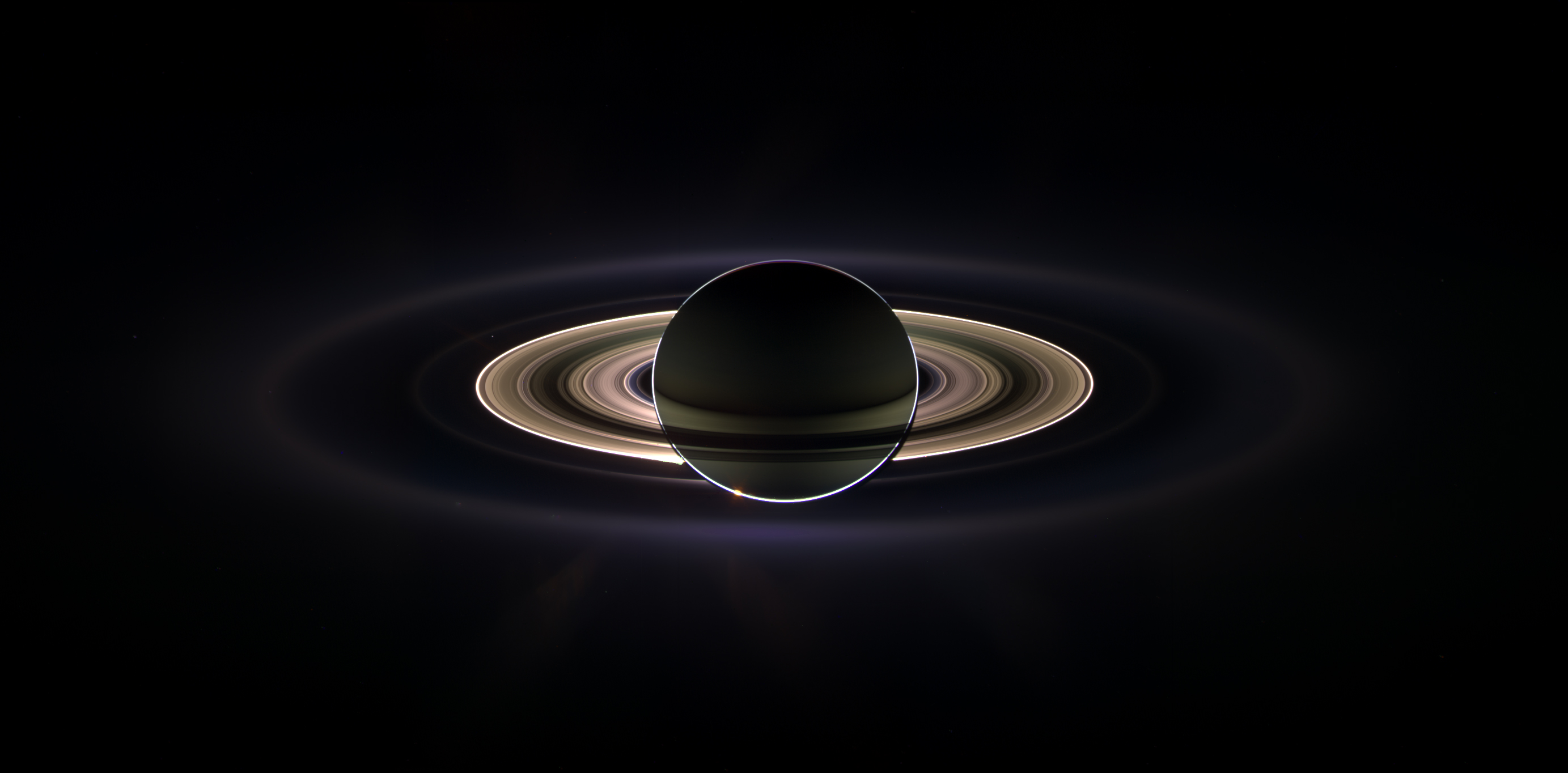
The rings are more varied and structured than imagined, composed of particles from house-size to a grain of dust.  It is a goldmine of information in the study of gravity and orbiting bodies and how they interact with one another.  Here is a beautiful image of Saturn and its rings, taken from a vantage point never before available.
Click for large image
The chat is available now in the Live Chat archive (click the link at the top of the left column and then click Archive) and soon as a Quicktime and MP3 file on the Home Page Archive.  Don't forget to take the quiz after you finish the chat - the pass code is at the end!

Thursday, February 3, 2011

Tissue Engineering and the International Space Station

By Dr. David Wolf, NASA Astronaut


The International Space Station National Laboratory has an edge for doing unique experiments in medicine and biotechnology that are not possible anywhere else—we can “turn off” gravity. As we gear up to fully use the station, the emerging field of tissue engineering is one of our high-value targets. This is a particularly promising area of study where microgravity research has already made advances in basic science. Indications are that further work will lead to important applications in clinical medicine on Earth.

Building on the groundwork from earlier programs, biotechnology research on the space station, and associated ground-based research in emulated microgravity, has created a large body of information. This data collection demonstrates the value of controlled gravity systems for assembling and growing 3-Dimensional living tissue from individual cells and substrates. The NASA-developed Space Bioreactor provides a core in-vitro capability both in space and on Earth.

Dr. Wolf, on Space Station Mir, repairing a faulty valve in the Space Bioreactor,
an instrument for precisely controlling the conditions enabling the culture of 3-D
human tissues in microgravity.
(NASA image)
On Earth, these bioreactors are unique in that they are able to emulate, within limits, the far superior fluid mechanical conditions achieved in space. One may think of this Space Bioreactor as a 3-D petri plate. The core of the instrumentation is a rotating fluid filled cylinder, the culture vessel, producing conditions inside resembling the buoyancy found within the womb. And much like in the human body, this vessel is surrounded by a life support system performing the functions of the heart and lung, achieving the precisely controlled conditions necessary for healthy tissue growth. The importance of this culture technique is that fluid mechanical conditions obtained in microgravity—and emulated on Earth—allow the growth of tissues in the laboratory that cannot be grown any other way. Emulated microgravity on Earth, and to a much greater degree, the actual microgravity of spaceflight enable an extremely gentle and quiescent fluid dynamic environment. The cells and substrates are free to organize into 3-D tissues without the need to introduce disruptive suspension forces from blades or stirring mechanisms. This leads to a broad array of applications based on enhanced in-vitro tissue culture techniques.
The ground-based versions of the Space Bioreactor produced very high fidelity colon tumors for cancer research, providing strong indications of the value of actual microgravity, see Figure 1. Even so, when I first put space grown tissue samples under the microscope, while aboard the Space Station Mir, I was astounded! In my many years of experience culturing tissues, I had never seen any so well organized, so healthy, and with such fine structure. Nerve derived tissue from the adrenal gland was forming long fronds of exceptionally delicate tissue, see Figure 2. What I was seeing could never form on Earth, even in our state-of-the-art systems that emulate microgravity.

Figure 1, An artificially produced colon cancer tumor produced
under emulated microgravity on Earth is composed of millions of
cancerous cells forming a 3-D configuration, much like that
which would form in the human body. Work conducted at NASA
in collaboration with Dr. Kim Jessup.
(Image courtesy of Dr. David Wolf)
Figure 2, Neural-derived adrenal tissue from a pheochromocytoma –
grown in actual microgravity. Photomicrograph taken by Dr. David Wolf
in work conducted on Mir in collaboration with Dr. Peter Lelkes.
(Image courtesy of Dr. David Wolf)
NASA research in the Space Bioreactors produced over 25 U.S. patents and the technology is considered state-of-the-art for ground-based tissue culture. Scientists around the globe from the National Institutes of Health or NIH, medical centers, and universities have produced numerous peer reviewed publications in highly respected journals and even more patents based on the fundamental principles. Other actual spaceflight research has been successfully used to study breast cancer and prostate cancer. NASA has licensed its patents to spin-off companies including Synthecon, Inc., for commercial manufacturing of the equipment, and Regenetech, Inc., for regenerative medicine and stem cell applications. These companies have in turn sublicensed the technology even more broadly, enabling widespread use of this NASA-developed technology.

Researchers on Earth use this technology to study cancer, stem cells, diabetes, cartilage growth, nerve growth, skin, kidney, liver, heart, blood vessels, infectious disease—virtually every tissue in the body. The applications go much further than engineering implantable tissue, to include vaccine production and living ex-vivo organic life support systems, such as artificial livers. Researchers at the NIH, for instance, used the methods to propagate the HIV virus, responsible for AIDS, in artificial lymph node tissue—itself sustained in the bioreactor. This resulted in the ability to study the virus life cycle under controlled conditions, outside the human body.

But we are not done. While very capable on Earth, the performance of Earth-bound bioreactors is still limited by the presence of gravity. Spaceflight testing on Mir and the space shuttle demonstrate that the growth of larger, better functioning, and more organized tissue may be obtained under true low gravity conditions. To date, the Space Bioreactor has been exploited primarily for basic research. During the intervening time, the field of medicine has evolved a firm vision towards true regenerative tissue technology. In recent years, powerful molecular biology techniques provided a detailed biological knowledge, which permits understanding cellular machinery almost like micro-machines. This convergence of technology with the space station laboratory opens a new chapter for space biotechnology.

The International Space Station National Laboratory now provides an unprecedented opportunity to the biotechnology community. Within NASA, scientists continue to work to build the infrastructure to enable the biotechnology community; to help them take the next steps in exploiting controlled gravity in-vitro systems. The vision is to team together the very best minds and institutions, leveraging their abilities to advance regenerative medicine. Such advances can lead to improving our quality of life on Earth and serve as a lasting legacy of the space station era.

Dr. David Wolf is an astronaut, medical doctor, and electrical engineer. Having traveled to space four times, Dr. Wolf participated in three short-duration space shuttle missions and a long-duration mission to the Russian Space Station Mir. A native of Indianapolis, he participated in seven spacewalks, and the SLS-2 Life Sciences Spacelab Mission, logging over 4,040 hours in space. He received the NASA Exceptional Engineering Achievement Medal, the NASA Inventor of the Year Award, among multiple recognitions for his work in advancing 3-D tissue engineering technology.

Wednesday, February 2, 2011

A Chance to Speak With Tomorrow's Leaders

By Administrator Charlie Bolden

A big part of NASA’s mission has always been to educate students and inspire the next generation of explorers, whether they're astronauts, scientists or engineers. That mission has never been more important than right now. The President has challenged us to win the future, and to do that, we must win the race to educate our children.

I had the privilege today to speak to a great group of students at the MathScience Innovation Center in Richmond, Virginia. It's always a pleasure to talk to young people. They are eager to create the future. These students know how important math and science is, and their teachers and parents know how important it is that they have a chance to learn and build skills in this area. Studying science, technology, engineering and math, or STEM, opens up many diverse career opportunities and helps our country create a future that innovates to solve problems, create new technologies to meet our needs, and explore the boundaries of our solar system and beyond.

What students across the United States and the students I met with today from Albert Hill Middle School learn today will help us be globally competitive tomorrow. Today, the students built paper rockets. Tomorrow, they may be putting the final touches on a new design for a NASA rocket that carries a science payload or a crew of humans into the next great chapter of exploration.

The President's call for us to win the future means we all need the skills and capabilities to stay competitive in the global economy. STEM education is not just about filling heads with knowledge. It’s about creating prosperity now and for future generations. As our commercial partners develop better and more cost effective ways for reaching low Earth orbit and we at NASA plan and design the missions that will explore our home planet in greater detail to reach for the outer solar system and beyond, good high-tech, high-paying jobs will continue to grow in the STEM fields. Students who study and prepare for the STEM fields will have the chance to take part in this whole universe of opportunities. As a result of their hard work and determination our country will be stronger and more competitive.

Here's a great picture of me learning from the students:
Photo credit: NASA/Paul Alers

Tuesday, February 1, 2011

Poll of the Week: Favorite Activities

Each week on the OLC, a new theme brings new activities.  We try to provide a variety of experiences that tie into the theme, and hope that they are entertaining as well as educational.  This week's Poll of the Week asked you which type of activity is your favorite.

The majority of respondents chose the 'Quiz' as their favorite activity.  This is indeed the most numerous type of activity, also being part of our Live Chat reporting.  We like the quiz as well for its ability to auto score your points so you can see them posted right away.  Other items may take up to ten days score and post. (If you applied for the Summer STEM Experience, don't worry.  Any points earned before the application cut-off date will be counted.) 

Coming in second is Models.  I am a huge proponent of learning through physical manipulation - doing something is better than reading or seeing something.  Constructing a model provides a corporeal manifestation of an object that can be handled a viewed from different angles and perspectives.  This week's Cassini model allows for the understanding of the systems that make up the spacecraft.  If you know of a cool model that we can share, let us know!

Here's what some of you had to say about  our modeling activities:
Models are probably the best part of the OLC. The Dawn and ISS models make awesome room decorations :)

I don't like them so much, but that's only because my printer can't print cardstock. :/ (Note: You can use regular paper - your model may not be as sturdy but the educational result will be the same!  JG)
I really enjoy making the models. Especially my ISS, even though my solar panels drooped considerably from gravity's effects on my heavy glue. But no matter, it graces the air above my desk.
Isn't it great to have friends that would understand that we like having models of space orbiters in our room.
I enjoy making models also.  They not only earn you 50 points but also allow you to have fun.  You also get to display them in your room.  Yeah, and it is great to know you are not the only person who has orbiters floating around all over the house.
This week's poll asks you opinion on the Greatest Wonder of the Solar System.  Take the poll, and then defend your choice on the Discussion Board

One more note: we encourage you to share ideas for polls in the drop box labeled 'Poll of the Week Ideas'.  Our recent poll on traveling to the Moon was suggested by Arman Jaffer, and I failed to give him his credit.  Thanks, Arman!