Robert Strain is the Center Director of NASA's Goddard Space Flight Center. Strain assumed his post on Aug. 4, 2008. Prior to joining NASA, Strain was the head of the Space Department at the Johns Hopkins University Applied Physics Lab in Laurel, Md.
During his tenure as head of the Space Department at APL, Strain oversaw the launch of a number of important scientific satellites including New Horizons, Messenger and STEREO. While at APL, he was also responsible for the national security business area which made many significant contributions to the Department of Defense and other U.S. agencies.
Strain joined APL in 2004 as assistant Space Department head for operations. The following year, he was named associate department head and then became the department’s managing executive.
He has more than 25 years of experience in the aerospace business, including executive positions at Orbital Sciences, where he led the company's Satellite and Electronic Sensors Divisions; and Fairchild Space and Defense Company, for which he served as chief financial officer and various other operational roles.
Strain was born in Flint, Mich., and grew up in Flushing, Mich. He attended college at Western Michigan University and received his bachelor’s degree in business administration.
Mr. Strain and his wife, Karen, reside in Poolesville, Md., and have three children.
Monday, January 25, 2010
Thursday, January 21, 2010
I Realized a Dream
By Dr. Elizabeth B. Ward
I began work at NASA Headquarters in Washington, DC in the fall of 1993 as a National Space Grant Post-Doctoral Fellow nearly twenty years after I first graduated from college. My undergraduate degree is in Chemistry from East Carolina University. I graduated from college in 1975 when there were no personal computers, no personal calculators, and no word processors. I learned math and science using a slide rule. I spent two years in graduate school doing research in analytical Chemistry and teaching fundamental chemistry labs. In 1977, just short of graduation with a Masters in Chemistry, I dropped out to marry and have children.
After my children reached school age, I taught chemistry and biology at the local community college. Teaching again helped me realize that I loved working with students and I enjoyed it much more than working in a lab. So I returned to college to earn a Masters of Science Teaching degree at the College of William and Mary in Virginia. I stayed on to earn a Doctor of Education degree. While taking classes at William and Mary, I continued to teach at the community college. I graduated with my doctorate in the spring of 1993 at the age of 39. My father suggested I apply to work at NASA because it was just down the road from where I lived. Not expecting a reply, I appeased my dad by sending a brief letter of introduction and my dissertation abstract to the NASA Headquarters Education Division.
Shortly after sending the letter, I was surprised by a phone call asking me to come for an interview. Less than a month later, I started work in Washington, DC for the National Space Grant Program. There I learned the inner workings of a large federal agency and interacted with employees from many other agencies including the National Science Foundation. During those six years, I traveled to most of the states in the US and visited almost all of the NASA field Centers. By working at the national level, I gained valuable experience that helped my later work for NASA Langley Research Center. I was also able to complete another Masters Degree, this one in Space Studies from the University of North Dakota.
Since 2000, I have worked on various projects at Langley Research Center. I currently work the Aeronautics Research Directorate and the Strategic Relationships Office where I manage international student activities for both the Exploration Systems and the Aeronautics Research Mission Directorates. When I was a child, I loved science and all things space related. I often thought I’d become an astronaut. A kidney stone at the age of 18 crushed the hope of becoming a space farer, but at the age of 39, I realized a dream by beginning my work for NASA. The past sixteen years have been filled with adventure and excitement. I’ve learned that students come in all ages, all nationalities, and with a range of abilities. Working with them and with the people who do the technical work at NASA is what I enjoy most about my job.
I began work at NASA Headquarters in Washington, DC in the fall of 1993 as a National Space Grant Post-Doctoral Fellow nearly twenty years after I first graduated from college. My undergraduate degree is in Chemistry from East Carolina University. I graduated from college in 1975 when there were no personal computers, no personal calculators, and no word processors. I learned math and science using a slide rule. I spent two years in graduate school doing research in analytical Chemistry and teaching fundamental chemistry labs. In 1977, just short of graduation with a Masters in Chemistry, I dropped out to marry and have children.
After my children reached school age, I taught chemistry and biology at the local community college. Teaching again helped me realize that I loved working with students and I enjoyed it much more than working in a lab. So I returned to college to earn a Masters of Science Teaching degree at the College of William and Mary in Virginia. I stayed on to earn a Doctor of Education degree. While taking classes at William and Mary, I continued to teach at the community college. I graduated with my doctorate in the spring of 1993 at the age of 39. My father suggested I apply to work at NASA because it was just down the road from where I lived. Not expecting a reply, I appeased my dad by sending a brief letter of introduction and my dissertation abstract to the NASA Headquarters Education Division.
Shortly after sending the letter, I was surprised by a phone call asking me to come for an interview. Less than a month later, I started work in Washington, DC for the National Space Grant Program. There I learned the inner workings of a large federal agency and interacted with employees from many other agencies including the National Science Foundation. During those six years, I traveled to most of the states in the US and visited almost all of the NASA field Centers. By working at the national level, I gained valuable experience that helped my later work for NASA Langley Research Center. I was also able to complete another Masters Degree, this one in Space Studies from the University of North Dakota.
Since 2000, I have worked on various projects at Langley Research Center. I currently work the Aeronautics Research Directorate and the Strategic Relationships Office where I manage international student activities for both the Exploration Systems and the Aeronautics Research Mission Directorates. When I was a child, I loved science and all things space related. I often thought I’d become an astronaut. A kidney stone at the age of 18 crushed the hope of becoming a space farer, but at the age of 39, I realized a dream by beginning my work for NASA. The past sixteen years have been filled with adventure and excitement. I’ve learned that students come in all ages, all nationalities, and with a range of abilities. Working with them and with the people who do the technical work at NASA is what I enjoy most about my job.
Wednesday, January 20, 2010
It’s All About What You Say And How You Say It
By Michael McPeake
Engineering is about doing great things in a group setting. It’s a group effort and it’s the group that succeeds. Hello, my name is Michael McPeake and I graduated from Purdue University in May with a BS in Aerospace Engineering. My senior design team tied for second place in NASA’s 2009 Fundamental Aeronautics Program design competition; as a result, I received an internship at NASA’s Ames Research Center. The work I did over the summer led to a part time position with a NASA subcontractor which is where I am currently working.
It seems rather surreal to be working at NASA. But looking back I can identify several things in my education that I found to be most useful. Team work and brainstorming experience during high school prepared me to take a more leadership position in group work at Purdue. I went to a project based learning high school, where science topics were taught through group projects instead of book assignments. Many high school physics courses use this teaching method to demonstrate fundamental physical principles. Communication courses are also very important in high school and college. Public speaking will force you to get familiar with public criticism, the same type of criticism that you may receive when pitching an idea to an engineering group.
Regardless of whatever field you do get into, it is important to get as much experience as possible during college. Recruiters’ look for industry experience and then at academic performance. The easiest way of doing this is to volunteer for an undergraduate research position for one of your professors. Then when summer comes around apply for internships at a company you’re interested in working at. Keep in mind that whatever industry you get into, you will have to deal with being the odd person out for awhile. People are very careful about allowing newcomers into their industry, and as such some of the biggest obstacles that you will encounter are those created by people who are threatened by your presence. Don’t let anyone tell you who you are, where you are going or how you are going to get there. The STEM (Science Technology Engineering and Mathematics) fields are growing and there many wonderful opportunities on the horizon.
Engineering is about doing great things in a group setting. It’s a group effort and it’s the group that succeeds. Hello, my name is Michael McPeake and I graduated from Purdue University in May with a BS in Aerospace Engineering. My senior design team tied for second place in NASA’s 2009 Fundamental Aeronautics Program design competition; as a result, I received an internship at NASA’s Ames Research Center. The work I did over the summer led to a part time position with a NASA subcontractor which is where I am currently working.
It seems rather surreal to be working at NASA. But looking back I can identify several things in my education that I found to be most useful. Team work and brainstorming experience during high school prepared me to take a more leadership position in group work at Purdue. I went to a project based learning high school, where science topics were taught through group projects instead of book assignments. Many high school physics courses use this teaching method to demonstrate fundamental physical principles. Communication courses are also very important in high school and college. Public speaking will force you to get familiar with public criticism, the same type of criticism that you may receive when pitching an idea to an engineering group.
Regardless of whatever field you do get into, it is important to get as much experience as possible during college. Recruiters’ look for industry experience and then at academic performance. The easiest way of doing this is to volunteer for an undergraduate research position for one of your professors. Then when summer comes around apply for internships at a company you’re interested in working at. Keep in mind that whatever industry you get into, you will have to deal with being the odd person out for awhile. People are very careful about allowing newcomers into their industry, and as such some of the biggest obstacles that you will encounter are those created by people who are threatened by your presence. Don’t let anyone tell you who you are, where you are going or how you are going to get there. The STEM (Science Technology Engineering and Mathematics) fields are growing and there many wonderful opportunities on the horizon.
Monday, January 18, 2010
Solar Dynamics Observatory
By Weekend Space Review
Scheduled for an upcoming winter launch is a new observatory to study the sun’s influence on Earth and the space around with the use of several instruments studying our star simultaneously on multiple wavelengths.
Just one of several upcoming missions to study the sun, the Solar Dynamics Observatory (SDO)’s goal is to better understand the energy that generates the suns magnetic field, and the energy used for the creation of solar winds, and other variations in solar activity.
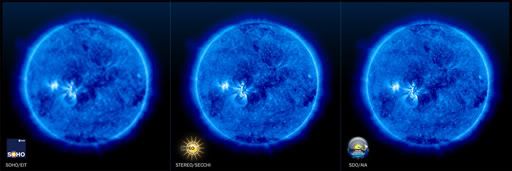
This image illustrates the resolution capabilities of the SDO, STEREO, and SOHO spacecrafts. SDO’s AIA instrument (right image) will have 1/2 greater image resolution than STEREO (middle image) and 3/4 greater imaging resolution than SOHO (left image). The image cadience also varies. SDO takes 1 image every .10 of a second. At best STEREO takes 1 image every 3 minutes and SOHO takes 1 image every 12 minutes.
SDO will measure the sun’s interior, its magnetic field, the plasmas of its solar corona, and other areas using 3 instruments. The Atmospheric Imaging Assembly which will image the sun’s atmosphere in multiple wavelengths, and compare data from sun’s interior. The Helioseismic and Magnetic Imager which will extend the capabilities and resolution of the SDO. And the Extreme Ultraviolet Variability Experiment which will measure the EUVs spectral irradiance to better understand the effects on the Earth’s Climate and Near-Earth space.
Just one of many instruments aboard the SDO. This is The Extreme Ultraviolet Variablity Experiment. It will measure the solar extreme-ultraviolet (EUV) irradiance with unprecedented spectral resolution, temporal cadence, and precision.
A February 3, 2010 launch date is the current target.
Scheduled for an upcoming winter launch is a new observatory to study the sun’s influence on Earth and the space around with the use of several instruments studying our star simultaneously on multiple wavelengths.
Just one of several upcoming missions to study the sun, the Solar Dynamics Observatory (SDO)’s goal is to better understand the energy that generates the suns magnetic field, and the energy used for the creation of solar winds, and other variations in solar activity.
This image illustrates the resolution capabilities of the SDO, STEREO, and SOHO spacecrafts. SDO’s AIA instrument (right image) will have 1/2 greater image resolution than STEREO (middle image) and 3/4 greater imaging resolution than SOHO (left image). The image cadience also varies. SDO takes 1 image every .10 of a second. At best STEREO takes 1 image every 3 minutes and SOHO takes 1 image every 12 minutes.
SDO will measure the sun’s interior, its magnetic field, the plasmas of its solar corona, and other areas using 3 instruments. The Atmospheric Imaging Assembly which will image the sun’s atmosphere in multiple wavelengths, and compare data from sun’s interior. The Helioseismic and Magnetic Imager which will extend the capabilities and resolution of the SDO. And the Extreme Ultraviolet Variability Experiment which will measure the EUVs spectral irradiance to better understand the effects on the Earth’s Climate and Near-Earth space.
Just one of many instruments aboard the SDO. This is The Extreme Ultraviolet Variablity Experiment. It will measure the solar extreme-ultraviolet (EUV) irradiance with unprecedented spectral resolution, temporal cadence, and precision.
A February 3, 2010 launch date is the current target.
Thursday, January 14, 2010
Making Aviation Safer
By Denise Jones
My story is probably different than most NASA researcher engineers. I didn’t go to school for engineering, aviation, or psychology. Back when I was coming along (late 70’s), my Dad would say, ‘Computers are the way of the future’. So I majored in computer science. I attended Old Dominion University in Norfolk, Virginia. While attending, I was a member of the Association for Computing Machinery. We took a tour of NASA Langley Research Center, which included the simulation facilities. I thought it would be really cool to work there, little to know that someday I would. I thought that only geniuses that were really good in math could work for NASA. That was not the case. I filed my resume with the University. My first supervisor scanned through the resumes and called me for an interview. He was looking for a researcher that could develop their own software for displays in the cockpit.
At first, working at NASA was a little overwhelming. I didn’t know anything at all about aviation or aircraft so I had to do a lot of reading and take short courses along the way. I also had to learn what it meant to be a Principal Investigator and the process required to conduct experiments. Thankfully, I had an outstanding mentor early in my career.
I have been working as a researcher at NASA for 26 years now. Most of that time I have worked in the area of crew / vehicle interface where concepts are developed for the flight deck and evaluated through piloted simulation and flight tests. My main tasks are to be knowledgeable about state-of-the-art in my research area, design and conduct studies, analyze data, and publish results to disseminate to the aviation community. My area of interest has been airport surface safety. I have conducted research on airport surface maps in which the flight crew is shown a moving map of the airport with the location of their aircraft and the locations of other traffic on the airport. Surface maps give the pilots additional information about the situation on the airport and help prevent them from getting lost. Airport moving maps are starting to be installed in aircraft today. I have also conducted quite a bit of research in the area of airport terminal area conflict prevention. The system onboard the aircraft can detect if there will be a potential collision with another aircraft on the airport surface, i.e. runway incursion, and the flight crew is alerted so they can take the appropriate action to avoid a collision. Companies are starting to develop this technology also. Maybe it will be installed in aircraft before I retire.
I am very thankful to have the opportunity to work for NASA. It has been very rewarding working with the high caliber people at NASA and the aviation community. It is very satisfying to have contributed to technology that will make aviation safer and may actually save lives.
My story is probably different than most NASA researcher engineers. I didn’t go to school for engineering, aviation, or psychology. Back when I was coming along (late 70’s), my Dad would say, ‘Computers are the way of the future’. So I majored in computer science. I attended Old Dominion University in Norfolk, Virginia. While attending, I was a member of the Association for Computing Machinery. We took a tour of NASA Langley Research Center, which included the simulation facilities. I thought it would be really cool to work there, little to know that someday I would. I thought that only geniuses that were really good in math could work for NASA. That was not the case. I filed my resume with the University. My first supervisor scanned through the resumes and called me for an interview. He was looking for a researcher that could develop their own software for displays in the cockpit.
At first, working at NASA was a little overwhelming. I didn’t know anything at all about aviation or aircraft so I had to do a lot of reading and take short courses along the way. I also had to learn what it meant to be a Principal Investigator and the process required to conduct experiments. Thankfully, I had an outstanding mentor early in my career.
I have been working as a researcher at NASA for 26 years now. Most of that time I have worked in the area of crew / vehicle interface where concepts are developed for the flight deck and evaluated through piloted simulation and flight tests. My main tasks are to be knowledgeable about state-of-the-art in my research area, design and conduct studies, analyze data, and publish results to disseminate to the aviation community. My area of interest has been airport surface safety. I have conducted research on airport surface maps in which the flight crew is shown a moving map of the airport with the location of their aircraft and the locations of other traffic on the airport. Surface maps give the pilots additional information about the situation on the airport and help prevent them from getting lost. Airport moving maps are starting to be installed in aircraft today. I have also conducted quite a bit of research in the area of airport terminal area conflict prevention. The system onboard the aircraft can detect if there will be a potential collision with another aircraft on the airport surface, i.e. runway incursion, and the flight crew is alerted so they can take the appropriate action to avoid a collision. Companies are starting to develop this technology also. Maybe it will be installed in aircraft before I retire.
I am very thankful to have the opportunity to work for NASA. It has been very rewarding working with the high caliber people at NASA and the aviation community. It is very satisfying to have contributed to technology that will make aviation safer and may actually save lives.
Tuesday, January 12, 2010
Which Career Path to Choose?
By Logan Hamel
When I began my studies at the University of Wisconsin - Madison I was unsure which career path to choose. I anticipated that I would enjoy engineering due to my success in mathematics and physics as well as my love for problem solving. However, I was not ready to select a specific discipline within engineering. During my second semester I began to realize that a degree in Engineering Mechanics and Astronautics would be an excellent fit. This degree would allow me to maximize my coursework in my favorite subject, classical mechanics. Furthermore, the degree would provide the opportunity to move into the aerospace industry which was a thought that created additional motivation. I believe that through exploration of our solar system, we will learn valuable information about ourselves and begin to better understand our place within this universe. Despite my excitement about my new major, as a freshman I was still not completely confident in my decision. I also believed civil engineering would be a good fit for me as it would allow me to make a more direct impact in the community. However, as I continued my coursework and studied topics including structural mechanics and advanced dynamics, I became increasingly confident in my decision to pursue Engineering Mechanics and Astronautics.
As a junior at UW-Madison I was lucky enough to be selected for the engineering co-op program at United Space Alliance (USA). I moved to Houston, TX to work in the Ascent/Descent Flight Design department. I was very excited and my time at USA was everything that I hoped it would be. I learned a great deal about NASA’s space shuttle program and I performed analysis on the sensitivity of shuttle contingency abort scenarios to monthly weather fluctuations. The experience made me realize how important my role as an engineer would be and thus it motivated me to work even harder when I returned to school in the fall.
Last year I returned to school to pursue my Masters of Science in Aerospace Engineering at Georgia Institute of Technology. At Georgia Tech my work has been focused on advanced rotorcraft design which was new to me at first, but I have found it to be a fascinating field of research. I will soon be graduating and I cannot wait to continue making my contributions to the aerospace engineering industry.
There have been two main highlights within my experience of engineering thus far. The first was the patenting of my senior design project, a ladder load lifting device. I was very excited to receive a patent so early in my career. It made me realize how much opportunity there is to impact our community through engineering. The second highlight was my experience as a member of Georgia Tech’s graduate student team which won first prize in NASA’s fundamental aeronautics program competition for the design of a supersonic airliner. I am very proud of the amount of progress my team was able accomplish in such a short time during the competition. The best part of each experience was working side by side with other motivated students who are equally passionate about aerospace design.
I believe that through hard work, dedication, and a little bit of luck all students will eventually find their way into a career which is motivating and inspiring.
When I began my studies at the University of Wisconsin - Madison I was unsure which career path to choose. I anticipated that I would enjoy engineering due to my success in mathematics and physics as well as my love for problem solving. However, I was not ready to select a specific discipline within engineering. During my second semester I began to realize that a degree in Engineering Mechanics and Astronautics would be an excellent fit. This degree would allow me to maximize my coursework in my favorite subject, classical mechanics. Furthermore, the degree would provide the opportunity to move into the aerospace industry which was a thought that created additional motivation. I believe that through exploration of our solar system, we will learn valuable information about ourselves and begin to better understand our place within this universe. Despite my excitement about my new major, as a freshman I was still not completely confident in my decision. I also believed civil engineering would be a good fit for me as it would allow me to make a more direct impact in the community. However, as I continued my coursework and studied topics including structural mechanics and advanced dynamics, I became increasingly confident in my decision to pursue Engineering Mechanics and Astronautics.
As a junior at UW-Madison I was lucky enough to be selected for the engineering co-op program at United Space Alliance (USA). I moved to Houston, TX to work in the Ascent/Descent Flight Design department. I was very excited and my time at USA was everything that I hoped it would be. I learned a great deal about NASA’s space shuttle program and I performed analysis on the sensitivity of shuttle contingency abort scenarios to monthly weather fluctuations. The experience made me realize how important my role as an engineer would be and thus it motivated me to work even harder when I returned to school in the fall.
Last year I returned to school to pursue my Masters of Science in Aerospace Engineering at Georgia Institute of Technology. At Georgia Tech my work has been focused on advanced rotorcraft design which was new to me at first, but I have found it to be a fascinating field of research. I will soon be graduating and I cannot wait to continue making my contributions to the aerospace engineering industry.
There have been two main highlights within my experience of engineering thus far. The first was the patenting of my senior design project, a ladder load lifting device. I was very excited to receive a patent so early in my career. It made me realize how much opportunity there is to impact our community through engineering. The second highlight was my experience as a member of Georgia Tech’s graduate student team which won first prize in NASA’s fundamental aeronautics program competition for the design of a supersonic airliner. I am very proud of the amount of progress my team was able accomplish in such a short time during the competition. The best part of each experience was working side by side with other motivated students who are equally passionate about aerospace design.
I believe that through hard work, dedication, and a little bit of luck all students will eventually find their way into a career which is motivating and inspiring.
Tuesday, January 5, 2010
NASA's Newest Center Director
On January 4, 2010, David McBride, the acting director at the Dryden Flight Research Center, received his official appointment as NASA's newest Center Director. Here is Mr. McBride's bio:
Center Director - David D. McBride
David D. McBride is director of NASA's Dryden Flight Research Center on Edwards Air Force Base, Calif. As such, he oversees all aspects of center management, strategy and operations at NASA Dryden, one of the 10 field centers of the National Aeronautics and Space Administration.
McBride became acting director on April 4, 2009 upon the retirement for former center director Kevin L. Petersen. He had served as Dryden's deputy director since June 8, 2008, first in an acting capacity and receiving the official appointment on January 4, 2009.
McBride's prior management assignments at NASA Dryden include serving as Associate Director for Programs, overseeing the complete portfolio of Dryden projects supporting Exploration, Science, and Aeronautics.
He also was program manager for NASA’s Flight Research Program at NASA Dryden. The Flight Research Program and Flight and Systems Demonstrations Project conducted flight research and discovery that expanded aerospace knowledge and capabilities – activities included the record-breaking flight of the solar-powered Helios aircraft to over 96,000 feet, the Active Aeroelastic Wing flight research project and the revolutionary Intelligent Flight Control System, demonstrating adaptive neural network flight control systems.
McBride's prior technical assignments include responsibilities as chief engineer for the X-33 Extended Test Range, and lead flight systems engineer for the X-31 and X-29 flight research programs and Dryden's F/A-18 Systems Research Aircraft.
During a hiatus from NASA, McBride served as executive vice president and chief information officer of McBride and Associates, Inc., Albuquerque, N.M., from 1993 through 1998.
McBride began his career at Dryden as a cooperative education student in 1982, specializing in the area of digital flight control systems analysis. He earned a Bachelor of Science degree in Electrical Engineering from the University of New Mexico in 1985 and an executive Masters of Business Administration from the University of New Mexico in 1998.
David D. McBride is director of NASA's Dryden Flight Research Center on Edwards Air Force Base, Calif. As such, he oversees all aspects of center management, strategy and operations at NASA Dryden, one of the 10 field centers of the National Aeronautics and Space Administration.
McBride became acting director on April 4, 2009 upon the retirement for former center director Kevin L. Petersen. He had served as Dryden's deputy director since June 8, 2008, first in an acting capacity and receiving the official appointment on January 4, 2009.
McBride's prior management assignments at NASA Dryden include serving as Associate Director for Programs, overseeing the complete portfolio of Dryden projects supporting Exploration, Science, and Aeronautics.
He also was program manager for NASA’s Flight Research Program at NASA Dryden. The Flight Research Program and Flight and Systems Demonstrations Project conducted flight research and discovery that expanded aerospace knowledge and capabilities – activities included the record-breaking flight of the solar-powered Helios aircraft to over 96,000 feet, the Active Aeroelastic Wing flight research project and the revolutionary Intelligent Flight Control System, demonstrating adaptive neural network flight control systems.
McBride's prior technical assignments include responsibilities as chief engineer for the X-33 Extended Test Range, and lead flight systems engineer for the X-31 and X-29 flight research programs and Dryden's F/A-18 Systems Research Aircraft.
During a hiatus from NASA, McBride served as executive vice president and chief information officer of McBride and Associates, Inc., Albuquerque, N.M., from 1993 through 1998.
McBride began his career at Dryden as a cooperative education student in 1982, specializing in the area of digital flight control systems analysis. He earned a Bachelor of Science degree in Electrical Engineering from the University of New Mexico in 1985 and an executive Masters of Business Administration from the University of New Mexico in 1998.
Subscribe to:
Posts (Atom)