By Don Petit, NASA Astronaut, Expedition 30/31
Looking through the cupola windows on Space Station, it’s only natural to reflect upon who we are and where we fit into the world below. Like something out of Alice in Wonderland, this orbital looking glass can be both a window through which to observe the jeweled sphere of Earth and a mirror that (sometimes, depending on your viewing angle) shows you a translucent reflection of yourself superimposed on the planet.
From orbit, the more you know about our planet, the more you can see. You see all the geological features described in textbooks. You see fault zones, moraines, basins, ranges, impact craters, dikes, sills, braided channels, the strike and dip of layered rocks, folding, meanders, oxbow lakes, slumps, slides, mud flows, deltas, alluvial fans, glaciers, karst topography, cirques, tectonic plates, rifts zones, cinder cones, crater lakes, fossil sea shores, lava flows, volcanic plumes, fissures, eruptions, dry lakes, inverted topography, latteric soils, and many more.
You see clouds of every description and combination: nimbus, cumulus, stratus, nimbo-cumulus, nimbo-stratus, cirrus, thunderheads, and typhoons, sometimes with clockwise rotation, sometimes with counter-clockwise. You notice patterns: clouds over cold oceans look different than clouds over warm oceans. Sometimes the continents are all cloud-covered, so you have no recognizable landmass to help you gauge where you are. If you see a crisscross of jet contrails glistening in the sun above the clouds, you know you are over the United States.
Lightning storms flash like gigantic fireflies looking for mates half a continent away. You see patterns on the ocean surface, swirls and vortices on large scales, wave diffraction patterns around capes, solitary waves forming long lines out in the middle of nowhere, and rivers that look like they are spilling milk chocolate into turquoise oceans.
You see light-scattering phenomena of all kinds—at sunrise, at sunset, across the terminator, 16 times a day. You see crepuscular rays, forward reddened lobes, off-axis blue lobes, and corona halos. With binoculars you can count six distinct layers in the atmosphere, with the outer one seemingly fading into fuzzy blackness.
The aurora is nothing short of occipital ecstasy. It is always moving, always changing, and like snowflakes, no two displays are the same. The glowing red and green forms meander like celestial amoebas crawling across some great petri dish. One time our orbit took us through the center of an auroral display. It was as if we were in a glowing fog of red and green. Had we been shrunk down and inserted into the tube of a neon sign? It looked like it was just on the other side of the windowpane. I wanted to reach out and touch, but of course I couldn’t. Afterwards, I had to clean nose prints off of the window.
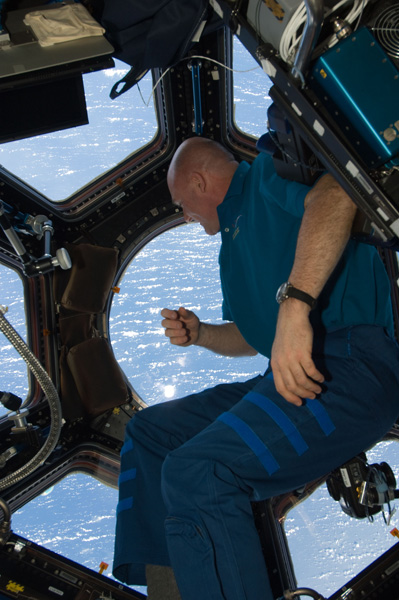
You catch an occasional meteor while looking down at Earth. You see stars and planets in oblique views, next to Earth’s limb. And they do not twinkle. Perchance you might spot a ragged shadow from a total solar eclipse projected onto Earth. Amazing, it looks just like it does in the textbooks! You have a godlike view of the finer details of shadowy projections onto spherical bodies. You see space junk orbiting nearby. Sometimes it flickers due to an irregularity, catching light as it rotates. An overboard water dump produces a virtual blizzard in the surrounding vacuum. Like strangers passing in the night, you see other satellites flash brilliantly for a few seconds, then fade into oblivion.
Jungles are the darkest land features you can observe in full sunlight. They are so dark that you need to open your camera lens to obtain a proper exposure. If there are clouds partly shrouding your view, you can be fooled into thinking you are over the ocean. Only when you notice rivers with braided channels and meandering loops of chocolate brown do you realize that it is jungle and not water. Farmland, rich with vibrant crops, is different. Farmland is bright, much brighter than the jungles. Here nature is giving us a clue as to the efficiency of light capture by plants.
The impact of humanity on Earth is humbling from orbit. Our greatest cities appear to the bare eye as minor gray smudges on the edges of continents—they could be the fingerprints of Atlas, from the last time he handled the globe. They are hardly distinguishable from volcanic ash flow or other geologic features. If you didn’t know it was a city, it would be difficult to conclude it was the result of human design. Under the scrutiny of the telephoto lens, things appear different. Like ants moving crumbs of dirt, we are slowly changing our world. You realize that Earth will do just fine, with or without us. We are wedded to this planet, for better or for worse, until mass extinction do us part.
Cities at night are different from their drab daytime counterparts. They present a most spectacular display that rivals a Broadway marquee. And cities around the world are different. Some show blue-green, while others show yellow-orange. Some have rectangular grids, while others look like a fractal-snapshot from Mandelbrot space.
Patterns in the countryside are different in Europe, North America, and South America. In space, you can see political boundaries that show up only at night. As if a beacon for humanity, Las Vegas is truly the brightest spot on Earth. Cities at night may very well be the most beautiful unintentional consequence of human activity.
This looking glass incites your mind to ponder the abstract. Through the window, you explore the world. In the mirror, you reflect upon your place within it and the reasons we explore. Is it fundamentally about finding new places to live and new resources to use? Or is it about expanding our knowledge of the universe? Either way, exploration seems fundamental to our survival as a species. After all, if the dinosaurs had explored space and colonized other planets, they would still be alive today.
Discuss this blog here: http://tinyurl.com/bloginspire
Tuesday, January 31, 2012
Friday, January 27, 2012
LiveChat Roundup: Jan. 26, 2012
By Jim Gerard, INSPIRE Education Specialist, KSC, FL
The Hubble Space Telescope's 21 years in orbit was the theme of last night's LiveChat with Dr. Frank Summers of the Space Telescope Science Institute in Baltimore, Maryland. Dr. Summers has visited our students before, sharing his experience as a visual developer and writer for the IMAX Hubble 3D film. Last night, he shared 21 memorable images from the 21 years of Hubble's work.
Did you know when HST was launched that it had an undetected major defect? The test stand used to check out the main mirror was slightly out of alignment, so when we checked out the telescope in orbit we discovered it could not focus properly. This defect in the mirror was later resolved through corrective lenses for the instruments on board, and adjustment of lenses in new instruments to account for the error. The result is what you remember most about Hubble - fantastic images that are as beautiful as they are scientifically important. Dr. Summer's insight of the images helped us understand the important milestones they represent.
If you missed Dr. Summer's chat, check for it soon in the LiveChat Archive, and don't forget to take the quiz to earn 25 points. And plan on attending next week's chat with Rachel Zimmerman-Brachmann of Ames Research Center, who will talk about Astrobiology and the search for life in our Solar System. Sign up today on the Discussion Board!
The Hubble Space Telescope's 21 years in orbit was the theme of last night's LiveChat with Dr. Frank Summers of the Space Telescope Science Institute in Baltimore, Maryland. Dr. Summers has visited our students before, sharing his experience as a visual developer and writer for the IMAX Hubble 3D film. Last night, he shared 21 memorable images from the 21 years of Hubble's work.
![]() |
| The image that started it all - The Pillars of Creation (the Eagle Nebulae) |
If you missed Dr. Summer's chat, check for it soon in the LiveChat Archive, and don't forget to take the quiz to earn 25 points. And plan on attending next week's chat with Rachel Zimmerman-Brachmann of Ames Research Center, who will talk about Astrobiology and the search for life in our Solar System. Sign up today on the Discussion Board!
Tuesday, January 24, 2012
I Wouldn't Have Believed
By Marie McBride, MUST Junior, Florida Institute of Technology
Hello! My name is Marie McBride. Originally, I am from Hermitage, Pennsylvania. I am currently a junior at Florida Institute of Technology in Melbourne, Florida. My major is Solar, Earth, and Planetary Science with a minor in physics. Eventually, I hope to get a PhD in Planetary Geology. In my lifetime my goal is to be the first woman to walk on the Moon. I have been working my hardest to make this dream a reality.
In the summer of 2011, I took a huge step towards my dream of becoming a moonwalker. I was selected to the NASA Lunar and Planetary Science Academy (LPSA). LPSA was an internship program at Goddard Space Flight Center in Greenbelt, Maryland. I was chosen by Dr. David R. Williams to assist him with his current project, The Restoration of Apollo Lunar Data. My job is to study the data from the lunar surface machines placed on the Moon by the Apollo astronauts from 1969-1972. Due to Apollo budget cuts the data has never been truly analyzed till now. After the summer, I was asked to continue my research through the academic year and I now make regular trips to Goddard.
If someone had told me even a year ago, that I would currently be working for NASA, I wouldn’t have believed them. Though, now that I have started I realized the possibilities in life are endless. There are so many opportunities in the world to do what you love, you just have to work hard and take the time to search for them.
I truly love where I am in life and would be happy to do anything I can to help anyone else be able to feel that way. Please don’t hesitate to contact me, I would be thrilled to share my experiences or answer questions.
Hello! My name is Marie McBride. Originally, I am from Hermitage, Pennsylvania. I am currently a junior at Florida Institute of Technology in Melbourne, Florida. My major is Solar, Earth, and Planetary Science with a minor in physics. Eventually, I hope to get a PhD in Planetary Geology. In my lifetime my goal is to be the first woman to walk on the Moon. I have been working my hardest to make this dream a reality.
In the summer of 2011, I took a huge step towards my dream of becoming a moonwalker. I was selected to the NASA Lunar and Planetary Science Academy (LPSA). LPSA was an internship program at Goddard Space Flight Center in Greenbelt, Maryland. I was chosen by Dr. David R. Williams to assist him with his current project, The Restoration of Apollo Lunar Data. My job is to study the data from the lunar surface machines placed on the Moon by the Apollo astronauts from 1969-1972. Due to Apollo budget cuts the data has never been truly analyzed till now. After the summer, I was asked to continue my research through the academic year and I now make regular trips to Goddard.
If someone had told me even a year ago, that I would currently be working for NASA, I wouldn’t have believed them. Though, now that I have started I realized the possibilities in life are endless. There are so many opportunities in the world to do what you love, you just have to work hard and take the time to search for them.
I truly love where I am in life and would be happy to do anything I can to help anyone else be able to feel that way. Please don’t hesitate to contact me, I would be thrilled to share my experiences or answer questions.
Friday, January 20, 2012
LiveChat Roundup: Jan. 19, 2012
By Jim Gerard, INSPIRE Education Specialist, KSC, FL
We had another visit from "Dr. Catastrophe" at last night's LiveChat. 60 students were on hand to hear Marshall Space Flight Center's meteor expert Dr. Bill Cooke talk about how battered our poor planet gets from extraterrestrial rocks.
37,000-78,000 tons of meteoric material falls on Earth each year. Earth's atmosphere protects us from most of the impactors by disintegrating them through ablation and vaporization. Even then, the dust and debris left over adds to the total weight of material. Large meteors may travel fast enough to create a shock wave that causes the object to explode in the atmosphere. Each year, military satellites detect megaton explosions in the atmosphere, some over populated areas. Thank you, atmosphere!
Occasionally, meteoroids are big enough or dense enough to survive a trip through the atmosphere, and reach the ground to become a meteorite. Surprisingly, if you found one immediately it would feel cool to the touch. The heated material is ablated away, and the rock's interior, chilled in space to -200˚, quickly cools the surface.
Dr. Cooke also talked about a network of cameras set up to detect and track fireballs. By capturing images from two different camera locations allows computer software to triangulate the sighting and determine distance, speed, and trajectory. More cameras are needed to better understand the frequency and nature of these objects that could seriously damage spacecraft in orbit.
Imagery from space will be the topic from returning presenter Dr. Frank Summers of the Space Telescope Science Institute. Dr. Summers was involved in choosing images for the IMAX movie "Hubble 3-D" and will describe the process of turning these images into three dimensional representations. Join us for this exciting LiveChat by signing up on the Discussion Board. See you there!
We had another visit from "Dr. Catastrophe" at last night's LiveChat. 60 students were on hand to hear Marshall Space Flight Center's meteor expert Dr. Bill Cooke talk about how battered our poor planet gets from extraterrestrial rocks.
37,000-78,000 tons of meteoric material falls on Earth each year. Earth's atmosphere protects us from most of the impactors by disintegrating them through ablation and vaporization. Even then, the dust and debris left over adds to the total weight of material. Large meteors may travel fast enough to create a shock wave that causes the object to explode in the atmosphere. Each year, military satellites detect megaton explosions in the atmosphere, some over populated areas. Thank you, atmosphere!
Occasionally, meteoroids are big enough or dense enough to survive a trip through the atmosphere, and reach the ground to become a meteorite. Surprisingly, if you found one immediately it would feel cool to the touch. The heated material is ablated away, and the rock's interior, chilled in space to -200˚, quickly cools the surface.
Dr. Cooke also talked about a network of cameras set up to detect and track fireballs. By capturing images from two different camera locations allows computer software to triangulate the sighting and determine distance, speed, and trajectory. More cameras are needed to better understand the frequency and nature of these objects that could seriously damage spacecraft in orbit.
Imagery from space will be the topic from returning presenter Dr. Frank Summers of the Space Telescope Science Institute. Dr. Summers was involved in choosing images for the IMAX movie "Hubble 3-D" and will describe the process of turning these images into three dimensional representations. Join us for this exciting LiveChat by signing up on the Discussion Board. See you there!
Thursday, January 19, 2012
Candid and the Camera
By Don Petit, NASA Astronaut, ISS Expedition 30/31
For my Soyuz launch, I had worn a standard Shuttle diaper with two inserts for extra absorption. (I have found it advantageous to add a little extra in certain places—in weightlessness, urine will creep around under the guise of capillary action and find your long underwear.)
Still, we were in our spacesuits for over 12 hours, and that’s a long time. Even with the extra inserts, my diaper became completely overwhelmed. It leaked real bad; I could feel it happen, and was powerless to control the flood. When the time came to de-suit, I was more than ready to get out of that thing, but dreaded the impending mess. Fortunately, I was able to cover up my stained underwear with a pair of woolen bib overalls.
On docking day, we put on our Sokol suits again and strapped in about six hours before arriving at Space Station. By the time we docked I was tired, dehydrated, hungry, had to use the bathroom, and was still wearing my yellow-stained long underwear. My sinuses were a bit congested, with the standard red puffy, chipmunk face. Our Soyuz cabin pressure was at 830 mm, but station is maintained at 740 mm. When we equalized the two, I got a splitting sinus headache.
When we opened the hatch we were immediately on camera, downlinked live to the world as we were greeted by the smiling faces of our space station crewmates. All I wanted to do was have a good “rest stop,” get something to drink, and hide in my sleep station (in that order). We were pulled into the Service Module, where we were once again on camera with Russian Mission Control and my family, all anxious to chat. They wanted to know what it was like. I felt like a red-faced, dehydrated, puffy sack of -- (fill in the blank). That is what it was really like. I was able to force a smile.
For my Soyuz launch, I had worn a standard Shuttle diaper with two inserts for extra absorption. (I have found it advantageous to add a little extra in certain places—in weightlessness, urine will creep around under the guise of capillary action and find your long underwear.)
Still, we were in our spacesuits for over 12 hours, and that’s a long time. Even with the extra inserts, my diaper became completely overwhelmed. It leaked real bad; I could feel it happen, and was powerless to control the flood. When the time came to de-suit, I was more than ready to get out of that thing, but dreaded the impending mess. Fortunately, I was able to cover up my stained underwear with a pair of woolen bib overalls.
On docking day, we put on our Sokol suits again and strapped in about six hours before arriving at Space Station. By the time we docked I was tired, dehydrated, hungry, had to use the bathroom, and was still wearing my yellow-stained long underwear. My sinuses were a bit congested, with the standard red puffy, chipmunk face. Our Soyuz cabin pressure was at 830 mm, but station is maintained at 740 mm. When we equalized the two, I got a splitting sinus headache.
| Let your smile be your umbrella! |
| Feeling better! |
Tuesday, January 17, 2012
Nothing is Impossible!
By Esther Lee, MUST Junior, Rutgers University, NJ
First day of junior year in high school, I walked into my first programming class, expecting to learn a new skill, to have a fun experience, to open up a new field of knowledge and… and then I realized I was the only girl in the class. All the expectations and thrill might have died a little. “Okay… that’s awkward,” I remembered saying to myself. And yes, it was awkward; growing up in an all-girls academy, I felt more than awkward! From that day on, I realized if I want to be in the STEM field, I should get rid of my shyness and get used to walking into a room full of guys, or better yet, working with them.
I’m Esther Lee, a junior in Mechanical Engineering with an Aerospace concentration at Rutgers University, NJ. Or, I simply sum up that mouthful into “I’m a proud engineer!” My interest in engineering began when I participated in my high school robotics team. Being on the team gave me a lot of hands-on experiences and taught me useful interpersonal skills. It provided me with a great understanding and experience of the engineering foundation. My robotics experience definitely helped me learn how to deal with guys and, most importantly, different types of personalities.
Aside from interpersonal challenges, I've also encountered a huge personal challenge: finding out what I want to become in life. I can understand, for some of you, the enormous stress of picking the "right" college and the "right" major, because these decisions seem to define the rest of your life. Key word here is "seem" - truth be told, I picked Mechanical Engineering over other available majors at my school based on my best guess. (Yay for process of elimination!) And that's part of what an engineer does – when there is not enough information, make the best guess and go with it. If that was not the best guess, well then, guess again! The key here is always try new things and don't be afraid to break out of your comfort zone a little; you never know what you will find on your adventures. Most importantly, it's okay to change your mind! I just so happen to LOVE being an engineer, but I do want to switch to a different type of engineering for my graduate degree, instead of staying in Mechanical. Your experiences are nothing but beneficial: even if you've made a mistake, you have now learned that you don't ever want to repeat the same mistake; you grow a little and you move onto other exciting things awaiting you in life. Taking that programming class in high school made me realize Computer Science is not my passion, so I pursued engineering instead!
A really important lesson that I've learned is to make the best out of your life and decisions: make decisions you won't regret and simply enjoy them! Rutgers was most certainly not my first choice. Unfortunately, due to financial reasons, I have decided that picking Rutgers would be the “smarter” choice. So, I ended up disliking a majority of my freshman year. But, as I expanded my social circle and gained new experiences, I've learned to take each chance I am given seriously and I've definitely realized there are endless opportunities out in the world, I just have to find them! It doesn't matter where you go to school - as long as you make the best of your experiences and take every chance/opportunity!
I recommend reaching out to professors, graduate students and upper-classmen for guidance, help, and advice – they’re usually amicable so don't be afraid to socialize and network because (most) people don't bite! (Don’t wait until you get into college to reach out! Start on college-visit trips, you might run into upperclassmen who are willing to help!) These people offer me tremendous help and I couldn't have gotten to where I am now without their support. As long as you’re genuinely interested in learning more, basically anyone would be more than happy to help you. It doesn't hurt to ask (Be genuine and within reasons, of course); in fact, you'd be surprised how asking could bring so much more to the table - that's how I found out about NASA internships! I was fortunate to have had two internships at NASA Ames. My first one was at a fluids mechanics lab, where I had hands-on experiences with wind-tunnel experiments. The second internship was with the ground data system of a satellite team where I worked as a programmer of the ground data system software. I absolutely love my times at NASA. They opened up opportunities for me to learn about possible career paths, network with professionals, make new friends, discover new opportunities and experiences, and try different things that I couldn’t do when occupied with school, such as dancing and learning how to bike! These work experiences also led me to realize I definitely do not want to be stuck in the same confined space all day!
Thinking about the unknown future is daunting, even for adults. Just know grades are not everything. Even college students make the same mistake of obsessing over their academic studies and neglect enjoying life/experiences. (I am definitely guilty of the same mistake, too.) Be a well-rounded and honest person. Honor, integrity, good work ethics, and a pinch of courage will take you anywhere you want - as long as you're willing to put in the effort, nothing is impossible!
First day of junior year in high school, I walked into my first programming class, expecting to learn a new skill, to have a fun experience, to open up a new field of knowledge and… and then I realized I was the only girl in the class. All the expectations and thrill might have died a little. “Okay… that’s awkward,” I remembered saying to myself. And yes, it was awkward; growing up in an all-girls academy, I felt more than awkward! From that day on, I realized if I want to be in the STEM field, I should get rid of my shyness and get used to walking into a room full of guys, or better yet, working with them.
I’m Esther Lee, a junior in Mechanical Engineering with an Aerospace concentration at Rutgers University, NJ. Or, I simply sum up that mouthful into “I’m a proud engineer!” My interest in engineering began when I participated in my high school robotics team. Being on the team gave me a lot of hands-on experiences and taught me useful interpersonal skills. It provided me with a great understanding and experience of the engineering foundation. My robotics experience definitely helped me learn how to deal with guys and, most importantly, different types of personalities.
Aside from interpersonal challenges, I've also encountered a huge personal challenge: finding out what I want to become in life. I can understand, for some of you, the enormous stress of picking the "right" college and the "right" major, because these decisions seem to define the rest of your life. Key word here is "seem" - truth be told, I picked Mechanical Engineering over other available majors at my school based on my best guess. (Yay for process of elimination!) And that's part of what an engineer does – when there is not enough information, make the best guess and go with it. If that was not the best guess, well then, guess again! The key here is always try new things and don't be afraid to break out of your comfort zone a little; you never know what you will find on your adventures. Most importantly, it's okay to change your mind! I just so happen to LOVE being an engineer, but I do want to switch to a different type of engineering for my graduate degree, instead of staying in Mechanical. Your experiences are nothing but beneficial: even if you've made a mistake, you have now learned that you don't ever want to repeat the same mistake; you grow a little and you move onto other exciting things awaiting you in life. Taking that programming class in high school made me realize Computer Science is not my passion, so I pursued engineering instead!
A really important lesson that I've learned is to make the best out of your life and decisions: make decisions you won't regret and simply enjoy them! Rutgers was most certainly not my first choice. Unfortunately, due to financial reasons, I have decided that picking Rutgers would be the “smarter” choice. So, I ended up disliking a majority of my freshman year. But, as I expanded my social circle and gained new experiences, I've learned to take each chance I am given seriously and I've definitely realized there are endless opportunities out in the world, I just have to find them! It doesn't matter where you go to school - as long as you make the best of your experiences and take every chance/opportunity!
I recommend reaching out to professors, graduate students and upper-classmen for guidance, help, and advice – they’re usually amicable so don't be afraid to socialize and network because (most) people don't bite! (Don’t wait until you get into college to reach out! Start on college-visit trips, you might run into upperclassmen who are willing to help!) These people offer me tremendous help and I couldn't have gotten to where I am now without their support. As long as you’re genuinely interested in learning more, basically anyone would be more than happy to help you. It doesn't hurt to ask (Be genuine and within reasons, of course); in fact, you'd be surprised how asking could bring so much more to the table - that's how I found out about NASA internships! I was fortunate to have had two internships at NASA Ames. My first one was at a fluids mechanics lab, where I had hands-on experiences with wind-tunnel experiments. The second internship was with the ground data system of a satellite team where I worked as a programmer of the ground data system software. I absolutely love my times at NASA. They opened up opportunities for me to learn about possible career paths, network with professionals, make new friends, discover new opportunities and experiences, and try different things that I couldn’t do when occupied with school, such as dancing and learning how to bike! These work experiences also led me to realize I definitely do not want to be stuck in the same confined space all day!
Thinking about the unknown future is daunting, even for adults. Just know grades are not everything. Even college students make the same mistake of obsessing over their academic studies and neglect enjoying life/experiences. (I am definitely guilty of the same mistake, too.) Be a well-rounded and honest person. Honor, integrity, good work ethics, and a pinch of courage will take you anywhere you want - as long as you're willing to put in the effort, nothing is impossible!
Friday, January 13, 2012
LiveChat Roundup: Jan. 12, 2012
By Jim Gerard, INSPIRE Education Specialist, KSC, FL
Our first LiveChat of 2012 introduced 90 INSPIRE students to the hunt for new worlds. Dr. Steve Howell, Associate Director of the Kepler Space Telescope at Ames Research Center in California, led participants through the science involved in detecting new planetary systems around nearby stars.
There are two primary methods to detecting planets around other stars. When a planet orbits a star, they actually revolve around a common center, causing the star to wobble a little. This wobble creates a Doppler shift in the spectrum of the star. More precise detection and advanced computer analysis has led to the discovery of many extrasolar planets.
Kepler use the second method, which is to observe the brightness of the star and detect any variability that would be caused by a planet obscuring any of its light as the planet revolves around the star. To date, over 2000 potential planets have been identified.
Future spacecraft will further image these exoplanets, detecting gasses in the atmosphere that would indicate the presence of life. In this we way will be one step closer to answering that age old question, "Are we alone?"
Next week, Bill Cooke, the 'Doctor of Disaster' at Marshall Space Flight Center will return to the LiveChat to talk about meteorite impacts and other threats from space. Sign up now on the Discussion Board.
Our first LiveChat of 2012 introduced 90 INSPIRE students to the hunt for new worlds. Dr. Steve Howell, Associate Director of the Kepler Space Telescope at Ames Research Center in California, led participants through the science involved in detecting new planetary systems around nearby stars.
There are two primary methods to detecting planets around other stars. When a planet orbits a star, they actually revolve around a common center, causing the star to wobble a little. This wobble creates a Doppler shift in the spectrum of the star. More precise detection and advanced computer analysis has led to the discovery of many extrasolar planets.
Kepler use the second method, which is to observe the brightness of the star and detect any variability that would be caused by a planet obscuring any of its light as the planet revolves around the star. To date, over 2000 potential planets have been identified.
Future spacecraft will further image these exoplanets, detecting gasses in the atmosphere that would indicate the presence of life. In this we way will be one step closer to answering that age old question, "Are we alone?"
Next week, Bill Cooke, the 'Doctor of Disaster' at Marshall Space Flight Center will return to the LiveChat to talk about meteorite impacts and other threats from space. Sign up now on the Discussion Board.
Wednesday, January 11, 2012
Gone for the Season
By Don Petit, NASA Astronaut, ISS Expedition 30/31
(Note: These blog posts, originally published in the Air&Space magazine website, are now available to NASA.)
Being absent for the holidays is collateral damage for an explorer, whatever the location. In Antarctica, the short Antarctic summer is when most exploration happens, and this falls over the Thanksgiving, Christmas, and New Year holidays. Maybe you can get home by Valentine’s Day; it is best to arrive bearing flowers, chocolate, and a smile. Family life can be tough on Antarctic explorers.
Similarly, the timing of spaceflights depends on orbital mechanics as well as seasonal meteorological conditions at the launch and landing sites. Like sailors in the past shipping out with the tides, space explorers have no control over these factors and must warp their plans to fit the conditions of the Universe.
I have had the good fortune to be on two missions to the space station and one to Antarctica. My collateral damage toll includes being on orbit for two Thanksgivings, Christmas, New Years, birthdays, anniversaries, a science fair, school plays, recitals, and Valentine’s Day (I was not there with flowers, chocolate, and a smile). While in Antarctica, I missed everything from November to February, but did make it home for Valentine’s Day (with flowers, chocolate, and a smile). Now, with this mission, my damage toll is rising. With our new internet capability on space station, I can at least send flowers. The essentials to bring with you into the wilderness of today are not flint, steel, and powder, but your credit card number and network login.
Meaningful exploration typically requires months away from home. Ultimately, it is the explorer who misses out on the significant family events. One should never forget that your family life goes on, with or without you.
Discuss this blog here: http://tinyurl.com/bloginspire
(Note: These blog posts, originally published in the Air&Space magazine website, are now available to NASA.)
Being absent for the holidays is collateral damage for an explorer, whatever the location. In Antarctica, the short Antarctic summer is when most exploration happens, and this falls over the Thanksgiving, Christmas, and New Year holidays. Maybe you can get home by Valentine’s Day; it is best to arrive bearing flowers, chocolate, and a smile. Family life can be tough on Antarctic explorers.
Similarly, the timing of spaceflights depends on orbital mechanics as well as seasonal meteorological conditions at the launch and landing sites. Like sailors in the past shipping out with the tides, space explorers have no control over these factors and must warp their plans to fit the conditions of the Universe.
I have had the good fortune to be on two missions to the space station and one to Antarctica. My collateral damage toll includes being on orbit for two Thanksgivings, Christmas, New Years, birthdays, anniversaries, a science fair, school plays, recitals, and Valentine’s Day (I was not there with flowers, chocolate, and a smile). While in Antarctica, I missed everything from November to February, but did make it home for Valentine’s Day (with flowers, chocolate, and a smile). Now, with this mission, my damage toll is rising. With our new internet capability on space station, I can at least send flowers. The essentials to bring with you into the wilderness of today are not flint, steel, and powder, but your credit card number and network login.
Meaningful exploration typically requires months away from home. Ultimately, it is the explorer who misses out on the significant family events. One should never forget that your family life goes on, with or without you.
Discuss this blog here: http://tinyurl.com/bloginspire
Tuesday, January 10, 2012
More MUST Advice
By Carolina Rojas Ramirez, MUST
My name is Carolina Rojas Ramirez, a 2011 NASA MUST Student. I was born and raised in Bogota, the capital city of Colombia. Five years ago I moved to the United States, and a week later I started attending high school as a freshman. It was not easy due to my poor English: I was basically mute and deaf. In order to improve I had to listen to music and watch TV only in English even if I did not understand (It works!). Six months later my family and I moved to Kentucky from New York, which was a very big change. In the Bluegrass State, I started to improve my English more while I attended high school and even more when I attended community college. Just a few months ago, I graduated from Hopkinsville Community College and transferred to the College of William and Mary to pursue a Bachelor’s Degree in Chemistry.
There are many reasons why I choose the College of William and Mary. Its closeness to home (over the summer my family and I moved from Kentucky to Virginia), awesome reputation, historic background, cool traditions, and academic standards. My choice of major has many reasons as well. I chose a STEM career, because since late elementary I always did better in science than in other subjects (especially literature), and I loved to know how things work. Chemistry explains how matter works which is very important because we are made up of matter, and we posses one of the most beautiful and rarest things in the universe: Life. This is why I choose the Biochemistry track for my major: it combines the sciences of matter and life.
I have enjoyed college so far. There are so many things to do that four years are not enough that is why some people go to graduate school apart from gaining more knowledge! You meet a lot of people, there are many opportunities to gain experiences like internships, and it helps you to prepare for the real world. Since I entered college I have enjoyed many great things, one of the main ones is being able to be part of the NASA family. My first internship opportunity came when I apply online in the NASA internship website. I had always thought that getting into NASA was almost impossible and that just super geniuses could do it. Once I discovered that with just one application I would be able to be considered for many opportunities at NASA I decided to give it a chance. I got accepted, and last summer I worked with polymers and nanotubes at Langley Research Center. Last summer, I also had the huge honor to get accepted into the MUST program which offers a scholarship and an internship (for next year) for minority students.
Some advice about the STEM field: Study hard, make friends (networking), be well rounded (do not focus heavily only on science), and most important ASK QUESTIONS! Many mistakes can be done by not asking questions, like missing a huge life opportunity or blowing up the Chemistry lab by not knowing what to do…
Discuss this blog here: http://tinyurl.com/bloginspire
My name is Carolina Rojas Ramirez, a 2011 NASA MUST Student. I was born and raised in Bogota, the capital city of Colombia. Five years ago I moved to the United States, and a week later I started attending high school as a freshman. It was not easy due to my poor English: I was basically mute and deaf. In order to improve I had to listen to music and watch TV only in English even if I did not understand (It works!). Six months later my family and I moved to Kentucky from New York, which was a very big change. In the Bluegrass State, I started to improve my English more while I attended high school and even more when I attended community college. Just a few months ago, I graduated from Hopkinsville Community College and transferred to the College of William and Mary to pursue a Bachelor’s Degree in Chemistry.
There are many reasons why I choose the College of William and Mary. Its closeness to home (over the summer my family and I moved from Kentucky to Virginia), awesome reputation, historic background, cool traditions, and academic standards. My choice of major has many reasons as well. I chose a STEM career, because since late elementary I always did better in science than in other subjects (especially literature), and I loved to know how things work. Chemistry explains how matter works which is very important because we are made up of matter, and we posses one of the most beautiful and rarest things in the universe: Life. This is why I choose the Biochemistry track for my major: it combines the sciences of matter and life.
I have enjoyed college so far. There are so many things to do that four years are not enough that is why some people go to graduate school apart from gaining more knowledge! You meet a lot of people, there are many opportunities to gain experiences like internships, and it helps you to prepare for the real world. Since I entered college I have enjoyed many great things, one of the main ones is being able to be part of the NASA family. My first internship opportunity came when I apply online in the NASA internship website. I had always thought that getting into NASA was almost impossible and that just super geniuses could do it. Once I discovered that with just one application I would be able to be considered for many opportunities at NASA I decided to give it a chance. I got accepted, and last summer I worked with polymers and nanotubes at Langley Research Center. Last summer, I also had the huge honor to get accepted into the MUST program which offers a scholarship and an internship (for next year) for minority students.
Some advice about the STEM field: Study hard, make friends (networking), be well rounded (do not focus heavily only on science), and most important ASK QUESTIONS! Many mistakes can be done by not asking questions, like missing a huge life opportunity or blowing up the Chemistry lab by not knowing what to do…
Discuss this blog here: http://tinyurl.com/bloginspire
Thursday, January 5, 2012
The Optical Innovation in NASA’s JWST
by Bridget Lane, Senior, Fairfax, Virginia
After Hubble, the National Aeronautics and Space Administration is making history yet again. Through implementation of optical design, NASA is creating what would become one of the most powerful telescopes in the world. Previously known as the Next Generation Space Telescope (or NGST), the James Webb Space Telescope is unique because of it’s previously unheard of optic design. A collaborative effort led by NASA that encompasses a total of seventeen countries, this telescope observes in infrared and has amazed the mind through it’s ingenious use of mirrors and optical science to create a telescope that will further the world’s observation and knowledge of the vast space above us. But although this telescope has many new and innovative aspects, it is the clear merge of science, technology and engineering into one inventive blend that truly leaves us facing a bright future with this telescope.
The James Webb Space Telescope is innovative in design and execution. It’s main feature is a very large, 6.5 meter mirror. With four specialized instruments to improve quality (the NIRCam or Near Infrared Camera, the NIRSpec or Near Infrared Spectrograph, the MIRI or the Mid-Infrared Instrument, and the FGS or Fine Guidance Sensor), the viewing capabilities of this telescope are unsurpassed. The infrared viewing design penetrates dust, providing a clearer image. This enables a much greater visual of the stars. In total, the James Webb Space Telescope will have an orbit that has a 800,000 kilometer radius. The orbit will have an elliptical shape and rotate around the second Lagrange Point (L2). The telescope is progressing in its design, constantly being perfected and specified even further than before. In completion, the telescope will bring a far greater knowledge of the galaxy than we have now. But out of all the innovative design functions of this massive undertaking, it’s the optical innovation that make the capabilities of this telescope stand out.
The unique optical design of the James Webb Space Telescope is based in the design of the mirrors. The central focus of the telescope is the three-mirrored anastigmatic. This anastigmatic has four optically designed surfaces- the primary mirror, the secondary mirror, the tertiary mirror, and the mirrors designed for precision steering. The primary mirror is a composition of smaller mirrors. Eighteen hexagonally shaped mirrors are attached to the backplane structure, holding the completed primary mirror. Coated in gold, the eighteen beryllium-reflector segments are so large that they must be folded together prior to launch. They will then unfold while in orbit. This means both the primary and secondary mirrors will require re-alignment while in space. In order to position the telescope and all the mirrored segments perfectly, NASA will use micro-motors and image plane wavefront sensing technology to specifically place the mirrors. The fixed, flat tertiary and steering mirrors help to ensure image stabilization. Each of these mirrors can be found mounted to an Aft Optics System or AOS, which in turn is attached to the primary mirror’s backplane. These new mirror ideas are an optical take on engineering that are making new waves in science, technology, and our current view of the stars. These optical innovations are creating a large change in the way we think about things. Without the clear optical components of the JWST, the telescope would not be possible.
Hubble may have retired, but NASA and the telescope itself has not. With a new and innovative optical design and structure, the James Webb Space Telescope is breaking new and unheard of scientific and technological ground. An effort of seventeen countries, the telescope will help distance our knowledge and observation of the world above us. This telescope’s optical design is one that reminds us of the truly bright future we have when facing the stars.
Discuss this blog here: http://tinyurl.com/bloginspire
Bibliography:
Masetti, Maggie. The James Webb Space Telescope. National Aeronautics and Space Administration, 2011. Web. 18 Nov 2011.
Clampin, Mark. “Optical Design of the James Webb Space Telescope (JWST).” Berkeley Astronomy Department. UC Berkeley, 2011. Web. 18 Nov 2011.
Howard, Joseph and Raymond Ohl. “Optical Alignment of James Webb Space Telescope Breaks New Ground.” SPIE Astronomy. SPIE, 2011. Web. 18 Nov 2011.
Wikipedia contributors. "James Webb Space Telescope." Wikipedia, The Free Encyclopedia. Wikipedia, The Free Encyclopedia, 19 Nov. 2011. Web. 20 Nov. 2011.
After Hubble, the National Aeronautics and Space Administration is making history yet again. Through implementation of optical design, NASA is creating what would become one of the most powerful telescopes in the world. Previously known as the Next Generation Space Telescope (or NGST), the James Webb Space Telescope is unique because of it’s previously unheard of optic design. A collaborative effort led by NASA that encompasses a total of seventeen countries, this telescope observes in infrared and has amazed the mind through it’s ingenious use of mirrors and optical science to create a telescope that will further the world’s observation and knowledge of the vast space above us. But although this telescope has many new and innovative aspects, it is the clear merge of science, technology and engineering into one inventive blend that truly leaves us facing a bright future with this telescope.
The James Webb Space Telescope is innovative in design and execution. It’s main feature is a very large, 6.5 meter mirror. With four specialized instruments to improve quality (the NIRCam or Near Infrared Camera, the NIRSpec or Near Infrared Spectrograph, the MIRI or the Mid-Infrared Instrument, and the FGS or Fine Guidance Sensor), the viewing capabilities of this telescope are unsurpassed. The infrared viewing design penetrates dust, providing a clearer image. This enables a much greater visual of the stars. In total, the James Webb Space Telescope will have an orbit that has a 800,000 kilometer radius. The orbit will have an elliptical shape and rotate around the second Lagrange Point (L2). The telescope is progressing in its design, constantly being perfected and specified even further than before. In completion, the telescope will bring a far greater knowledge of the galaxy than we have now. But out of all the innovative design functions of this massive undertaking, it’s the optical innovation that make the capabilities of this telescope stand out.
The unique optical design of the James Webb Space Telescope is based in the design of the mirrors. The central focus of the telescope is the three-mirrored anastigmatic. This anastigmatic has four optically designed surfaces- the primary mirror, the secondary mirror, the tertiary mirror, and the mirrors designed for precision steering. The primary mirror is a composition of smaller mirrors. Eighteen hexagonally shaped mirrors are attached to the backplane structure, holding the completed primary mirror. Coated in gold, the eighteen beryllium-reflector segments are so large that they must be folded together prior to launch. They will then unfold while in orbit. This means both the primary and secondary mirrors will require re-alignment while in space. In order to position the telescope and all the mirrored segments perfectly, NASA will use micro-motors and image plane wavefront sensing technology to specifically place the mirrors. The fixed, flat tertiary and steering mirrors help to ensure image stabilization. Each of these mirrors can be found mounted to an Aft Optics System or AOS, which in turn is attached to the primary mirror’s backplane. These new mirror ideas are an optical take on engineering that are making new waves in science, technology, and our current view of the stars. These optical innovations are creating a large change in the way we think about things. Without the clear optical components of the JWST, the telescope would not be possible.
Hubble may have retired, but NASA and the telescope itself has not. With a new and innovative optical design and structure, the James Webb Space Telescope is breaking new and unheard of scientific and technological ground. An effort of seventeen countries, the telescope will help distance our knowledge and observation of the world above us. This telescope’s optical design is one that reminds us of the truly bright future we have when facing the stars.
Discuss this blog here: http://tinyurl.com/bloginspire
Bibliography:
Masetti, Maggie. The James Webb Space Telescope. National Aeronautics and Space Administration, 2011. Web. 18 Nov 2011.
Clampin, Mark. “Optical Design of the James Webb Space Telescope (JWST).” Berkeley Astronomy Department. UC Berkeley, 2011. Web. 18 Nov 2011.
Howard, Joseph and Raymond Ohl. “Optical Alignment of James Webb Space Telescope Breaks New Ground.” SPIE Astronomy. SPIE, 2011. Web. 18 Nov 2011.
Wikipedia contributors. "James Webb Space Telescope." Wikipedia, The Free Encyclopedia. Wikipedia, The Free Encyclopedia, 19 Nov. 2011. Web. 20 Nov. 2011.
Wednesday, January 4, 2012
What You MUST Know
Motivated Undergraduates in Science and Technology, or MUST, students are reaching out to the OLC to share their college experiences and what motivated them to pursue a STEM degree. During the holidays, MUST students who were alumni of INSPIRE shared in a special LiveChat about “Life After INSPIRE” (you can see this chat in the LiveChat archives on the Home page). They are also writing blogs to answer some of your questions about what happens after you graduate. Here are some answers from MUST student Michael Barnes.
• I was originally born in Washington D.C. and I currently reside in Capitol Heights, Maryland.
• I am currently a senior at The Ohio State University majoring in Electrical & Computer Engineering.
• The reason I decided to pursue an education is because I truly enjoyed going to class everyday and I wanted to expand my knowledge. With the world becoming more global and competitive, I knew that I needed to further my education and college has helped prepare me. I chose my path in STEM because of my 1st internship at Goddard Space Flight Center. Before interning there, I did not have an idea of what I wanted to do in college but this 1st internship changed my perspective. I had the opportunity to work with computers, robots and engineers for the first time and that experience helped lay the foundation for my STEM career.
• The biggest challenge I encountered while being in college was adjusting to the rigor of the coursework. Coming from high school, I did not have the same type of academic preparation as some of my peers in college and I had to learn material in college that some students were exposed to in high school. These classes included chemistry, physics, calculus, etc… This was a challenge because I had to work even harder in the classroom due to the fact I was catching up to the material. College can seem daunting because it moves at a fast pace and that can be tough to overcome.
• I was able to overcome this challenge by displaying a strong determination to succeed. I knew that I had some limitations coming into college but I did not let that deter me. Ohio State has various resources on campus that I utilized in order to help me. The school has a writing center, tutoring for math classes, tutoring for science classes, counseling and professional development help. Going to office hours with my professors was a tremendous asset as well. It was here that I gained a relationship with my professors and got much needed help in the classroom.
• The best thing I like about college is the diversity that you will encounter. At Ohio State, there is so much diversity within the classroom, social aspects and professional aspects as well. Having diversity allows me to see other perspectives and helps me grow as a student.
• Since I have been at Ohio State, I have had the opportunity to intern at Goddard Space Flight Center engaging in various activities. During my time there, I have worked on a network security project, orbital debris project and also got a chance to work with Electrical parts in a laboratory. These internships allowed me to gain experience working at a renowned facility and also to see cutting-edge research/projects. I truly enjoyed the people at Goddard and the culture there. Employees were dedicated to their work and they provided a positive environment while I was there.
Comment on this blog http://tinyurl.com/bloginspire.
• I was originally born in Washington D.C. and I currently reside in Capitol Heights, Maryland.
• I am currently a senior at The Ohio State University majoring in Electrical & Computer Engineering.
• The reason I decided to pursue an education is because I truly enjoyed going to class everyday and I wanted to expand my knowledge. With the world becoming more global and competitive, I knew that I needed to further my education and college has helped prepare me. I chose my path in STEM because of my 1st internship at Goddard Space Flight Center. Before interning there, I did not have an idea of what I wanted to do in college but this 1st internship changed my perspective. I had the opportunity to work with computers, robots and engineers for the first time and that experience helped lay the foundation for my STEM career.
• The biggest challenge I encountered while being in college was adjusting to the rigor of the coursework. Coming from high school, I did not have the same type of academic preparation as some of my peers in college and I had to learn material in college that some students were exposed to in high school. These classes included chemistry, physics, calculus, etc… This was a challenge because I had to work even harder in the classroom due to the fact I was catching up to the material. College can seem daunting because it moves at a fast pace and that can be tough to overcome.
• I was able to overcome this challenge by displaying a strong determination to succeed. I knew that I had some limitations coming into college but I did not let that deter me. Ohio State has various resources on campus that I utilized in order to help me. The school has a writing center, tutoring for math classes, tutoring for science classes, counseling and professional development help. Going to office hours with my professors was a tremendous asset as well. It was here that I gained a relationship with my professors and got much needed help in the classroom.
• The best thing I like about college is the diversity that you will encounter. At Ohio State, there is so much diversity within the classroom, social aspects and professional aspects as well. Having diversity allows me to see other perspectives and helps me grow as a student.
• Since I have been at Ohio State, I have had the opportunity to intern at Goddard Space Flight Center engaging in various activities. During my time there, I have worked on a network security project, orbital debris project and also got a chance to work with Electrical parts in a laboratory. These internships allowed me to gain experience working at a renowned facility and also to see cutting-edge research/projects. I truly enjoyed the people at Goddard and the culture there. Employees were dedicated to their work and they provided a positive environment while I was there.
Comment on this blog http://tinyurl.com/bloginspire.
Subscribe to:
Posts (Atom)
