
By Casey Takahashi
Summer is always fun. This summer I was able to attend some of the INSPIRE Virtual Stem Experiences. Those were great! I loved how interactive they were. (NOTE: Three plants sprouted--one died, one is tall and skinny with no leaves yet, and the other one I'm not really sure if it's a basil plant! lol) I also had time to catch up on many of the Live Chats I missed out on over the year. Then I went to COSMOS, which is a summer camp put on by the University of California. There are 4 campuses that host students (UC San Diego, UC Davis, UC Irvine, and UC Santa Cruz). Each campus offers 8 different subjects, and you can apply for one, two or three (but you only get chosen for one). I wanted computer science, physics (it was about light and optics), and bioengineering (red blood cell) at UCSD. I got my first choice, computer science. I lived and ate in one of the dorms with one roommate. Everyone would get up in the morning, eat breakfast, go to lectures, have lunch, then do lab work or talk in a discussion group in the afternoon. Sometimes we’d go on a field trip! In the evenings, we’d hang out with our suite and play games and bond. It’s a mix of hard work and play. There are different papers you have to write, and at the end of the 4 weeks you need to complete a project, make a poster board, and deliver a presentation to the staff, parents and other family members. I didn’t get a lot of sleep, especially toward the end, but it was extremely rewarding. I topped off my summer with a trip to Disneyland!! ! My summer was great, beginning to end.
Discuss this blog here: http://tinyurl.com/bloginspire12
Wednesday, October 3, 2012

Tuesday, October 2, 2012
My Experience at the Wings of Heroes Panel Discussions
By Olivia Humes
How many Space-Age heroes can you fit into one room? Over the course of the day on Sunday, September 23rd, 2012 a mix of twelve astronauts, cosmonauts, and flight controllers came together to discuss the past and future of manned spaceflight and international cooperation in space exploration, at an event hosted by Museum of Flight in Seattle, Washington.
The morning began with a panel representing a diverse selection of NASA missions, from Apollo to Skylab to the early flights of the Space Shuttle. Buzz Aldrin himself began the event with an inspirational excerpt from his forthcoming book. An interactive discussion of NASA’s future plans and the experiences of the astronauts ensued. Members of the audience were encouraged to ask questions, and the atmosphere in the room was jovial. The astronauts themselves, including Gerald Carr, Owen Garriott, Jack Lousma, and Buzz Aldrin, have quite a sense of humor, giving us anecdotes about their time in space. These ranged from the awe of seeing the earth from above to the often laughable predicaments of space hygiene. All in all, it was fascinating to meet these astronauts in person, and see for myself how “down-to-earth” they really are.
The second panel had a slightly different focus. In addition to technicians and astronauts, this panel also included two cosmonauts-- Alexi Leonov and Valery Kubasov. Charles Simonyi, a civilian astronaut, was also included on the panel and he shared his unique perspective. This second round of presenters discussed the Apollo-Soyuz Test Project, a program that fostered international cooperation between the two superpowers pitted against each other in the Cold War. Learning how to work together in a time of intense conflict between the two nations helped to smooth tensions between the US and Soviet Union. Until attending this event, I hadn’t realized how much politics can influence science, in particular, space exploration. It was also fascinating to get the Russian perspective on the project, and learn more about the Russian space program in general.
Each of the participants brought a different perspective to the discussion. Buzz Aldrin stressed the importance of further efforts towards a manned mission to Mars. Owen Garriott and Gerald Carr both discussed what could be accomplished with current technology in low earth-orbit. All of the Skylab astronauts shared the common experience of looking towards the Earth and seeing how beautiful and fragile it looked from so far away. Both of the Russian cosmonauts emphasized how the docking technology pioneered during the Apollo-Soyuz Test Project has been invaluable in building and operating the International Space Station. However, all of the speakers talked about the importance of science, technology, engineering and math in their careers and encouraged the youth in the audience to contribute to these areas.
This amazing opportunity to meet my heroes is something that I will never forget. I am fortunate that I was able to participate in this event, and grateful to the astronauts, cosmonauts and mission controllers that made this experience possible.
What question would you like to ask an astronaut? In this video, I ask the Skylab astronauts what the biggest challenge of living in space was, and Jack Lousma gives me a humorous response:
http://www.youtube.com/watch?v=ySOh_rPLXCM&feature=youtu.be
This Seattle Times article gives a review of the event, including quotes from the discussion:
http://seattletimes.com/html/localnews/2019244623_spaceexhibit24m.html
Discuss this blog here: http://tinyurl.com/bloginspire12
How many Space-Age heroes can you fit into one room? Over the course of the day on Sunday, September 23rd, 2012 a mix of twelve astronauts, cosmonauts, and flight controllers came together to discuss the past and future of manned spaceflight and international cooperation in space exploration, at an event hosted by Museum of Flight in Seattle, Washington.
The morning began with a panel representing a diverse selection of NASA missions, from Apollo to Skylab to the early flights of the Space Shuttle. Buzz Aldrin himself began the event with an inspirational excerpt from his forthcoming book. An interactive discussion of NASA’s future plans and the experiences of the astronauts ensued. Members of the audience were encouraged to ask questions, and the atmosphere in the room was jovial. The astronauts themselves, including Gerald Carr, Owen Garriott, Jack Lousma, and Buzz Aldrin, have quite a sense of humor, giving us anecdotes about their time in space. These ranged from the awe of seeing the earth from above to the often laughable predicaments of space hygiene. All in all, it was fascinating to meet these astronauts in person, and see for myself how “down-to-earth” they really are.
The second panel had a slightly different focus. In addition to technicians and astronauts, this panel also included two cosmonauts-- Alexi Leonov and Valery Kubasov. Charles Simonyi, a civilian astronaut, was also included on the panel and he shared his unique perspective. This second round of presenters discussed the Apollo-Soyuz Test Project, a program that fostered international cooperation between the two superpowers pitted against each other in the Cold War. Learning how to work together in a time of intense conflict between the two nations helped to smooth tensions between the US and Soviet Union. Until attending this event, I hadn’t realized how much politics can influence science, in particular, space exploration. It was also fascinating to get the Russian perspective on the project, and learn more about the Russian space program in general.
Each of the participants brought a different perspective to the discussion. Buzz Aldrin stressed the importance of further efforts towards a manned mission to Mars. Owen Garriott and Gerald Carr both discussed what could be accomplished with current technology in low earth-orbit. All of the Skylab astronauts shared the common experience of looking towards the Earth and seeing how beautiful and fragile it looked from so far away. Both of the Russian cosmonauts emphasized how the docking technology pioneered during the Apollo-Soyuz Test Project has been invaluable in building and operating the International Space Station. However, all of the speakers talked about the importance of science, technology, engineering and math in their careers and encouraged the youth in the audience to contribute to these areas.
This amazing opportunity to meet my heroes is something that I will never forget. I am fortunate that I was able to participate in this event, and grateful to the astronauts, cosmonauts and mission controllers that made this experience possible.
What question would you like to ask an astronaut? In this video, I ask the Skylab astronauts what the biggest challenge of living in space was, and Jack Lousma gives me a humorous response:
http://www.youtube.com/watch?v=ySOh_rPLXCM&feature=youtu.be
This Seattle Times article gives a review of the event, including quotes from the discussion:
http://seattletimes.com/html/localnews/2019244623_spaceexhibit24m.html
Discuss this blog here: http://tinyurl.com/bloginspire12
Monday, October 1, 2012
I Earned College Credit
By Danielle
Fournier
Mr. Gerard
asked us in his opening blog for the year to post about what we did this
summer. I had a great time spending part of my summer at Carleton College where
I earned college credit in Quantitative Reasoning. The program integrated math
and statistics with major social sciences: political science and international
relations, economics, and psychology. There were three Carleton professors
teaching the program and the students were broken into groups of about 15 to
each work with one professor. From those groups we were broken down into
smaller groups to tackle a major project in addition to taking daily classes
and working on small projects with each of the professors and some upper level
Carleton students.
My team
designed and engaged in a research project exploring the effect of dropping out
of college on income, as compared to people who graduate high school but do not
attend college. We also took into account the impact of race on the results. I
hadn’t had a statistics class before this program and I had a great time
learning to understand statistics and analyze data. It turns out that I really
enjoy statistics. I was nice to be part
of a group of students where everyone was excited about math. In case you are wondering, our group determined
that college dropouts earn 17% more than high school graduates per year and
race does not affect those results. We presented our analysis and results
in writing and in a public presentations, culminating at the end of the program
in an oral exposition of findings using text, figures, and graphs. This school
year I am taking AP Statistics and using a lot of the skills that I learned
during the summer program. Also, I am definitely planning to apply to Carleton and
some other liberal arts colleges next year.
Discuss this blog here: http://tinyurl.com/bloginspire12
Discuss this blog here: http://tinyurl.com/bloginspire12
Friday, September 21, 2012
Live Chat Roundup 9/20/12
By Jim Gerard, INSPIRE Education Specialist, KSC, FL
Anyone got the new iPhone yet? Communication is a huge industry, and an important part of every space science mission. Last night's LiveChat featured Peter Ilott, the Jet Propulsion Laboratory's director of Communication and System Operations. He discussed with the 55 INSPIRE students gathered the engineering and technology involved in communication with Mars.
Although it is possible to communicate directly with the Curiosity rover on the surface of Mars, most data is relayed through one of three orbiting science probes. The relay allows the rover to carry a smaller antenna to the surface (less mass) and lessons power requirements.
 Students had a great time asking questions about the transmitted data rate, the length of time the signal travels, and other engineering questions. All will be heard on the archive recording, available by Monday. Don't forget to get the password and take the quiz!
If science is your thing, come next week to hear Charles Budney, Science Office Manager, Mars Program Office. He will update the OLC on the MRL science mission. LiveChat begins at 8pm CT, with the INSPIRE Cafe open two hours earlier. No sign up needed for either. See you there next Thursday!
Discuss this blog here: http://tinyurl.com/bloginspire12
Anyone got the new iPhone yet? Communication is a huge industry, and an important part of every space science mission. Last night's LiveChat featured Peter Ilott, the Jet Propulsion Laboratory's director of Communication and System Operations. He discussed with the 55 INSPIRE students gathered the engineering and technology involved in communication with Mars.
Although it is possible to communicate directly with the Curiosity rover on the surface of Mars, most data is relayed through one of three orbiting science probes. The relay allows the rover to carry a smaller antenna to the surface (less mass) and lessons power requirements.

If science is your thing, come next week to hear Charles Budney, Science Office Manager, Mars Program Office. He will update the OLC on the MRL science mission. LiveChat begins at 8pm CT, with the INSPIRE Cafe open two hours earlier. No sign up needed for either. See you there next Thursday!
Discuss this blog here: http://tinyurl.com/bloginspire12
Wednesday, September 19, 2012
Endeavour's Last Flight
By Jim Gerard, INSPIRE Education Specialist, KSC, FL

This morning I woke early to make my way to the Shuttle Landing Facility at KSC to say goodbye to an old friend. Not that I had any physical connection to her, the way my colleagues who are engineers and technicians have had. But, we do share a little history.
In 1986 I was teaching 8th grade Earth Science the fateful morning we lost Challenger and her crew. My students knew my interest in space and saw how much it affected me. I continued to push forward, emphasizing the gains of such a dangerous enterprise. I emphasized the commitment of the nation with the news in 1987 of a new orbiter, OV-105, to be built out of structural spare parts, and to replace the lost vehicle.
Then in the following year, NASA announced the honor of naming the new orbiter would go to school students. The 'Name the Orbiter' contest began, where student groups would prepare projects to promote their choice of a name. My students wanted to enter the contest, and we selected the name Endeavour. Our project was to paint a life size orbiter outline in the parking lot, using math to determine size based on a scale model of the shuttle. We also included a packet about the name, making the discovery that the original Endeavour was used by James Cook to circumnavigate the globe doing scientific research, including witnessing a transit of Venus from the South Pacific.
When the finalists were selected, we were not among them, although the name Endeavour was selected and we all felt a pride that it was our choice. The next year I was hired by NASA, and on hand to witness the first launch of our namesake. Now, 24 years later, and too soon in my opinion, she is on her way to a retirement in California, the state of her birth.
Godspeed, Endeavour. May you continue to inspire in exhibit as you did in flight.
Discuss this blog here: http://tinyurl.com/bloginspire12
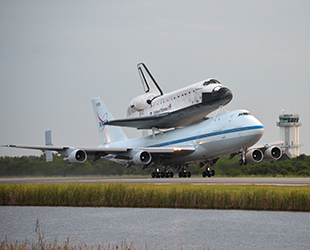
This morning I woke early to make my way to the Shuttle Landing Facility at KSC to say goodbye to an old friend. Not that I had any physical connection to her, the way my colleagues who are engineers and technicians have had. But, we do share a little history.
In 1986 I was teaching 8th grade Earth Science the fateful morning we lost Challenger and her crew. My students knew my interest in space and saw how much it affected me. I continued to push forward, emphasizing the gains of such a dangerous enterprise. I emphasized the commitment of the nation with the news in 1987 of a new orbiter, OV-105, to be built out of structural spare parts, and to replace the lost vehicle.
Then in the following year, NASA announced the honor of naming the new orbiter would go to school students. The 'Name the Orbiter' contest began, where student groups would prepare projects to promote their choice of a name. My students wanted to enter the contest, and we selected the name Endeavour. Our project was to paint a life size orbiter outline in the parking lot, using math to determine size based on a scale model of the shuttle. We also included a packet about the name, making the discovery that the original Endeavour was used by James Cook to circumnavigate the globe doing scientific research, including witnessing a transit of Venus from the South Pacific.
When the finalists were selected, we were not among them, although the name Endeavour was selected and we all felt a pride that it was our choice. The next year I was hired by NASA, and on hand to witness the first launch of our namesake. Now, 24 years later, and too soon in my opinion, she is on her way to a retirement in California, the state of her birth.
Godspeed, Endeavour. May you continue to inspire in exhibit as you did in flight.
Discuss this blog here: http://tinyurl.com/bloginspire12
Friday, September 14, 2012
LiveChat Roundup 9/14/12
By Jim Gerard, INSPIRE Education Specialist, KSC, FL
Last night began our season of LiveChats featuring NASA subject matter experts. INSPIRE staff members will still be on hand, and step in if an emergency arises, but we have an exciting schedule ahead for our LiveChats!
 Our first speaker was aerospace engineer Jordan Evans from the Jet Propulsion Laboratory. Jordan has been working on Curiosity and getting it to the surface of Mars. He described the difficulties of living on Mars time, where your time is shifted to correspond to the location of the rover. Some great questions kept Jordan busy with his insights to the MSL. If you missed it, it will be available in the LiveChat archive, found on the Home page. Don't forget to wait for the password and take the quiz!
And, before each LiveChat, you will have the opportunity to our new feature, the INSPIRE Cafe. The idea came from a real place, right here at Kennedy Space Center Headquarters right next to the cafeteria. Our CyberCafe gives an informal place to meet up with folks, have a beverage, and chat with folks from other offices. Our INSPIRE Cafe is the perfect place to have realtime chat with your online friends, ask for homework help, and hold team meetings if you are engaged in a competitive challenge. Just click the link on the Home page starting at 6pm CT each Thursday and you'll go right to the chat (don't forget to enter your full name when prompted!). See you the Cafe!
Discuss this blog here: http://tinyurl.com/bloginspire12
Last night began our season of LiveChats featuring NASA subject matter experts. INSPIRE staff members will still be on hand, and step in if an emergency arises, but we have an exciting schedule ahead for our LiveChats!
 Our first speaker was aerospace engineer Jordan Evans from the Jet Propulsion Laboratory. Jordan has been working on Curiosity and getting it to the surface of Mars. He described the difficulties of living on Mars time, where your time is shifted to correspond to the location of the rover. Some great questions kept Jordan busy with his insights to the MSL. If you missed it, it will be available in the LiveChat archive, found on the Home page. Don't forget to wait for the password and take the quiz!
 And, before each LiveChat, you will have the opportunity to our new feature, the INSPIRE Cafe. The idea came from a real place, right here at Kennedy Space Center Headquarters right next to the cafeteria. Our CyberCafe gives an informal place to meet up with folks, have a beverage, and chat with folks from other offices. Our INSPIRE Cafe is the perfect place to have realtime chat with your online friends, ask for homework help, and hold team meetings if you are engaged in a competitive challenge. Just click the link on the Home page starting at 6pm CT each Thursday and you'll go right to the chat (don't forget to enter your full name when prompted!). See you the Cafe!
Discuss this blog here: http://tinyurl.com/bloginspire12
Wednesday, September 5, 2012
Return of the Blog!
By Jim Gerard, INSPIRE Education Specialist, KSC, FL

Welcome back to the INSPIRE Blog!
You'll notice a few changes on the Connect page, and there may be a few more additions as we restructure our online presence. Let me take a minute to tell you where things are.
On the top of the frame you will see links to the Discussion Board, the Leaderboard, and the LiveChat/INSPIRE Cafe access. Below that is the INSPIRE Blog in its usual place.
The right column starts with an active leaderboard that will show the top-ten point earners (Note: Until we have points earned we will display the results from last year's Leaderboard.) You'll notice on the Leaderboard a category for "Team". Our community will be assigned to four teams for some 'intramural' activities. Your team will have a dedicated Discussion Board forum and an INSPIRE staff member to help out.
Below the Leaderboard is the NASAINSPIRE Twitterfeed. If you already have a Twitter account, don't forget to follow NASAINSPIRE and receive the tweets as soon as they are sent. If you don't (or can't) have Twitter, than you can use this feed to catch up. Beneath the Twitterfeed are some other NASA sponsored social media that may interest you.
And, of course, the INSPIRE Blog. This will be a place to read first-person accounts of NASA missions, business, and activities. But it is also a place for YOU to share YOUR story with your fellow community members. Just place your story in the Dropbox named "INSPIRE Blog" and you'll be awarded 10 points.
To start off, here is a topic starter: "You won't believe what I did this summer!" I'm looking forward to reading your submissions!
Discuss this blog here: http://tinyurl.com/bloginspire

Welcome back to the INSPIRE Blog!
You'll notice a few changes on the Connect page, and there may be a few more additions as we restructure our online presence. Let me take a minute to tell you where things are.
On the top of the frame you will see links to the Discussion Board, the Leaderboard, and the LiveChat/INSPIRE Cafe access. Below that is the INSPIRE Blog in its usual place.
The right column starts with an active leaderboard that will show the top-ten point earners (Note: Until we have points earned we will display the results from last year's Leaderboard.) You'll notice on the Leaderboard a category for "Team". Our community will be assigned to four teams for some 'intramural' activities. Your team will have a dedicated Discussion Board forum and an INSPIRE staff member to help out.
Below the Leaderboard is the NASAINSPIRE Twitterfeed. If you already have a Twitter account, don't forget to follow NASAINSPIRE and receive the tweets as soon as they are sent. If you don't (or can't) have Twitter, than you can use this feed to catch up. Beneath the Twitterfeed are some other NASA sponsored social media that may interest you.
And, of course, the INSPIRE Blog. This will be a place to read first-person accounts of NASA missions, business, and activities. But it is also a place for YOU to share YOUR story with your fellow community members. Just place your story in the Dropbox named "INSPIRE Blog" and you'll be awarded 10 points.
To start off, here is a topic starter: "You won't believe what I did this summer!" I'm looking forward to reading your submissions!
Discuss this blog here: http://tinyurl.com/bloginspire
Subscribe to:
Posts (Atom)